
Previous Sermons
Looking for our livestream? Head over to our YouTube channel.
-
 • 5/24/26
I am the True Vine (05/24/26)
Back in 1927, there was a man by the name of Paul Mazur working on a complicated problem in the U.S. The complicated problem? Americans weren’t buying enough stuff and Paul and other businessmen were concerned the frugality of Americans would slow the economy down. Paul wondered: what if we can stop people from knowing how to fix their clothes and instead convince them they need to buy new ones if a button falls off? Paul helped articulate the changes in a Harvard Business Review article:
“We must shift America from a needs to a desires culture. People must be trained to desire, to want new things even before the old have been entirely consumed. We must shape a new mentality. Man's desires must overshadow his needs.”
This marked the beginning of a new chapter in advertising with a single goal: sell you more stuff. This year, advertisers will spend at least $500 billion dollars to show you content that is meant to form you into a type of person. Each swipe of your news feed shapes you, each podcast forms your mind and heart, and each TV show reinforces a narrative. And can I let you in on a secret?
These things are destructive to our souls. We live in a culture constantly training us to desire more, compare more, and strive more. And while many things contribute to rising anxiety and depression, it’s hard to believe this constant pressure leaves our souls untouched. We’ve become connected to things that cause us and those around us great harm. But, what if there was another option? What if the thing we’re connected to brings us good fruit? That’s what Jesus offers us today as we abide, remain, or make ourselves at home in him.
We’re in the final week of our I AM series in the Gospel of John. This series is based on the most important question Jesus ever asked—and still asks us today which is “Who do you say I am?” As we look to answer that, we can find ourselves in the Gospel According to John. One unique feature of John’s Gospel is the seven ‘I AM’ statements—where Jesus reveals that he is God in the flesh. We’re going to focus on the seventh and final I AM statement today – I am the true vine.
Will you stand if you’re able as we read John 15:1-9?
The Failure of the First Vine
Before we get into the goodness of this passage, we need to first understand why Jesus says “I am the TRUE Vine.” That means there was such a thing as a false vine or a vine that may have produced bad fruit. So, what is Jesus getting at?
There are two Old Testament references (written a few hundred years before Jesus arrived on-scene) we need to understand: Isaiah 5 and Psalm 80. Isaiah 5. In both passages, we learn that God calls Israel his vine. When they stayed connected to him, they were to produce good fruit for the gardener. God shares that he brought them out of Egypt, he protects his vine, and lovingly cares for his vine. But, what does he get in return? Isaiah 5:7 says this:
“The vineyard of the LORD Almighty is the house of Israel, and the men of Judah are the garden of his delight. And he looked for justice but saw bloodshed; for righteousness, but heard cries of distress.”
Despite God’s faithfulness, he gets bloodshed from his people. Does that sound like Israel is bearing good fruit for God? No. Psalm 80 is a lament and a plea from the people of Israel for God to remember his promises to them. Asaph, the Psalmist, pleads with God to suspend his judgement on the people, forgive them for their failures, and to watch over the vine once more. Psalm 80 pleads with God in a striking foreshadowing of what’s to come:
“Return to us, O God Almighty! Look down from heaven and see! Watch over this vine, the root your right hand has planted, the son (some translations use branch) you have raised for yourself. Let your hand rest on the man at your right hand, the son of man you have raised up for yourself. Then we will not turn away from you; revive us, and we will call on your name. Restore us, O LORD God Almighty, make your face shine upon us, that we may be saved.”
In light of the resurrection of Jesus, Psalm 80 can take on a whole new meaning. Jesus is the Son, he called himself the Son of Man. Psalm 80 is lamenting over the fact that Israel cannot be the vine God wants them to be. The Psalm anticipates a faithful Son who will succeed where Israel failed, that’s why Jesus says: “I am the True Vine.”
But, it begs the question: how did Israel end up failing? If they were the vine connected to God and meant to bear good fruit, what happened to them?
Two Sources of Bad Fruit
They had two core issues that caused them to wither and lose their connection to God. There are two issues (amongst many) we can see in Exodus:
1. Forgetting what God has done.
Before they left Egypt, they saw the wondrous power of God through his plagues and his covenantal love to his people. But when they got to the Red Sea, did they believe God’s power and love would bring them through? No, they said it would have been better to live as slaves in Egypt than die in the desert. God ends up parting the Red Sea and saving his people once again. Shortly after that, Israel began to grumble about food. They said: “In Egypt, while we were slaves, we could eat all we wanted!” God ends up sending Manna in the morning and Quail in the evening. I wish I could say they stopped doubting God and complaining but they didn’t.
Rather than abiding in God and trusting in his faithfulness, they doubted God could do it again. They had forgotten his past faithfulness so they had given up on his future faithfulness. That takes us to the second issue they faced in Exodus…
2. Failing to wait on God.
After Moses had been up on Mt. Sinai for 40 days, the people of Israel got tired of waiting for him to come back down. They didn’t think that God was going to show up for them so they strove by taking matters into their own hands. They didn’t believe that God, who rescued them from slavery, could give them the fruit they needed so they decided to try to bear fruit themselves. They did this by asking Aaron to create for them a golden calf who could be their God. Despite everything that God did for them, how they all saw his power, and experienced his loving kindness towards them in the past– they abandon the LORD because they’re tired of waiting for him to show up.
Moses finds out about this and fiercely rebukes them, he intercedes on behalf of the people and you know what God does? He forgives the people again. Time and time again, God has proven that he is worthy of their trust and shown that he can help them. Does Israel learn its lesson? No – they continue to doubt all throughout their journey to the promised land and when they finally get there, they don’t trust that God will give them a victory.
Why do they keep struggling with these issues? Israel doubted that God truly loved them. When they faced challenges in the present moment, they believed God had abandoned them despite his past history. When they grew tired of waiting, they didn’t trust in God’s love and took matters into their own hands.
And when they doubt God’s love, they severed the connection between them and God. Did they get good fruit or bad fruit? They got bad fruit – loss, judgement, and pain. God wants his people to bear good fruit but they need to want that for themselves.
If we’re not careful, we can read the Old Testament with a sense of superiority.
How easy is it for us to forget how God has been faithful in the past? When you’re faced a hardship or are walking through a struggle, it becomes hard to see how God is going to bring you through it but he will and he will work all things for good for those who love him and are called for his purpose. If you’re forgetful of what God’s done for you in the past, I’d encourage you to take the time to write down 1 thing you’re thankful for each day or share that at your dinner table. If you fill up a notebook with things you’re thankful for, I believe you will begin to see more clearly how God has been faithful to you.
And when we don’t trust him the way we should, we strive to take matters into our own hands. We may not build a golden calf but we’ll put our trust in something else. If there’s economic uncertainty, some of you may be tempted to put your trust in gold bars or what you have in savings but you won’t bother to trust in God. If there’s hardship in our lives, we won’t ask: God, what do you want to teach me in this season? We’ll do whatever we can to make life easier. We bear good fruit by trusting God even in hard times. And if you have a hard time trusting God, bring those doubts to God – Thomas, one of Jesus’ disciples, had no problem airing his doubt. God can handle yours too, name it, and see how God answers you.
That’s why Jesus says “I Am the True Vine” to demonstrate that he is finally doing what Israel could never accomplish – he is the means through which God will cause good fruit to bear amongst his people. Jesus will always do the Father’s will unlike Israel. Jesus will always remember God’s faithfulness and trust him completely. Why does Jesus do that? Because he deeply loves his Father and he deeply loves you. He is the one who has authority to forgive sin – against God and neighbors alike. He is the one who can give you new life if you turn to him in faith. And when we turn to him in faith, we find that abiding in Jesus is what we were made for. But how do we actually do that?
How do we abide?
I want you to zero in on verse 9 of our passage for the day. What does it say? It says: “As the Father has loved me, so have I loved you. Now abide in my love.”
How does the Father love Jesus? Matthew 3:17 tells us: The NLT puts it this way: “This is my dearly loved child, who brings me great joy.”
Then, what does Jesus say in John 15? He says he loves us the way the father loves him. Jesus views us the way that we just read. Brothers & Sisters: do you believe that deep in your bones? That God delights in you? Not just the perfect you - the one who spends hours reading the bible, never getting angry with others, serving all the time, or in constant fellowship with God.
No, God delights in you - the real you. The you who cries at the end of a long day because you just feel like life can’t get any harder. The you who can’t sleep so you stare at the ceiling paralyzed by anxiety and poor choices in the past. The you who has a messy prayer life, who struggles to read the bible but does it anyways, and the you who wants to believe that God delights in you but has some challenges with accepting it. In this rush to meet our self-imposed spiritual quotas or guidelines, we miss the beauty of the present moment with Jesus. We forget that our relationship with Him isn’t based on a checklist or a timer. It’s based on our ability to abide in him.
You may be thinking to yourself: yes, that sounds nice, Anthony. But right now, I feel like God is putting me through so many trials and things feel so hard. My friends: that may very well be evidence of God’s love for you. What does Jesus say? He says that the gardener prunes the one he loves and the ones who are bearing fruit. Alternatively, you may be thinking to yourself: Anthony, you have no idea about that one thing I did and I just know God can’t love me because of it. My dear friend: you cannot out-sin the grace of God. Jesus Christ knew exactly what he was doing when he went to the cross.
As a Father to three kids, I want my kids to abide or remain in my love for them too. I want them to know I delight in them – from taking an interest in my daughter’s dollhouse, to playing this little sleeping game with my oldest son every morning, or to giving my youngest son lots of ticklish kisses. I want them to know that they are my pride and joy. Since they’re my pride and joy, that means I care about the people that they are becoming which means I prune them or discipline them. I don’t do that because I’m cruel. I do it because I want my kids to exhibit self-control, respect for others, kindness, and love. But, they don’t get there automatically – it takes correction or pruning. When we set them in time-out, the first thing we say to them is: “Do you know that mommy and daddy love you, no matter what you do?” Then, we go into pruning or discipline mode.
And that’s what God does with us. He assures us of his love for us no matter what but that also means he’s shaping us into people who bear fruit for his glory. So as we continue to abide and rest in our identity as God’s dearly loved children, our lives will begin to change and start to look different than others. So…
What does a life of abiding look like?
As Jesus is describing what it means to bear fruit, there are multiple ways we could go. For today’s purposes, I want to give two examples of what a life of abiding looks like based on Jesus’ words in John 15:
1. Joy despite your circumstances. In Acts 5, there’s this strange little story. Peter and the rest of the apostles are brought into the Sanhedrin which is a high council of the Jewish people. The Sanhedrin are upset because Peter and the apostles are continuing to teach that Jesus is King and that he is alive. Peter and the apostles tell the Sanhedrin that they need to obey God rather than man. The Sanhedrin don’t have reason to criminally charge Peter and his friends so they instead whip them and then release them. And you know what Acts 5:41-42 says?
41 The apostles left the Sanhedrin, rejoicing because they had been counted worthy of suffering disgrace for the Name. 42 Day after day, in the temple courts and from house to house, they never stopped teaching and proclaiming the good news that Jesus is the Messiah.
Why in the world would they be rejoicing? Because their joy wasn’t rooted in something temporary like comfort, success, or other people’s approval. No, their joy was rooted in Jesus. They were connected to him and knew they were deeply known and loved. They knew that injustice would not have the final word and that even suffering could not separate them from Christ. Their suffering was real but what was more real was their connection to the true vine.
But like their teacher, they can’t just be people who love God and move to a monastery. No, they’re loved by God and because of that, abiding leads to…
2. Love for your neighbor.
This is what Jesus says later on in verse 12. He tells us that when we abide in him, we will bear good fruit. An example of that good fruit is how we love our neighbor. This is the fundamental reality of the Christian faith: Love God and love your neighbor. Sure, there’s other things going on but Jesus said those two things are the most important. We need discernment in this day and age because this command is often ignored. It is biblically inconsistent to say that you love God then spew hatred or cause harm to your neighbor. These are all signs of bad fruit and a sign that you’re not connected to the true vine.
But when you are connected to the true vine, love for your neighbor is one of the clearest indicators of good fruit in your life. And that good fruit is never so that you’ll look extra special or really good but rather, the good fruit is so that the world will know that you are a disciple of Christ and they will give glory to God. Keep that theme in mind as I share this story and I did get permission from the Hoffmans and Tammy to share this as well.
This past Monday as most of you should know by now, Tammy’s mother suddenly died. That night, we were wrapping up a connect group meeting at our home when Tammy got the call from her dad that he thinks Shirley is dead. Obviously, Tammy became distraught and was crying. She tells her dad to call 911 and she’s hurriedly packing her things up to get to her parent’s house. After she gets off the phone, Sue and Dave Hoffman are immediately by her side. They tell Tammy she’s not going alone and that we’ll be going with her. So, Sue and Tammy head out in one car with Dave and me in the other. Sue continued to comfort Tammy on the hard drive over. When we got there, it was a tough scene but Sue and Dave calmly stayed present with Tammy and suggested we head to the back of the house with Skip (Tammy’s dad) so the EMTs could have space. Even though it was a hard situation, Dave and Sue continued to show love and compassion for their neighbors by sitting with Skip, giving hugs to Tammy, and more. After we had left Tammy’s parents house, the Hoffmans went over to Tammy’s home to take care of her dogs so she had one less thing to worry about.
Why would Sue and Dave do that? They could have easily said: “It’s really late” or “there’s plenty of help with the EMTs” or “This isn’t our job, it’s Anthony’s job.” They didn’t say any of that, they just loved their neighbor, Tammy. Why? The Hoffmans are followers of Jesus who abide in the love of Christ. They know that Christ has loved them through his life, death, and resurrection. They know they are now called to love and sacrifice just like Jesus did.
And when I asked the Hoffmans if it’s okay to share this, they were both insistent that this isn’t about them. It’s about the glory of God and a simple way to be present and love their neighbor. But, you don’t get to abide in the love of Jesus by accident or chance, it takes practice.
So, after today, what should you do differently with your life? As I shared at the beginning of our time together, we live in a world that is constantly trying to form and shape us into a certain type of person. People are constantly trying to form you into the mentality of: “You need to strive more so you can get a higher paying job, reach a more peaceful place, get that perfect house, go on that perfect trip, etc.” But, my invitation to you and Jesus’ in this passage is this: Don’t strive, just abide. Abiding isn’t inactivity — it’s learning to live from God’s love rather than for God’s love.
This week, I want you to start or end your day with a simple practice. I want you to kneel or sit in a spot with your eyes closed. I want you to just slow your breathing and pray through Matthew 3:17 that says: “This is my dearly loved child, who brings me great joy.” That’s what God the Father says to Jesus. But in light of what Christ has done for you if you receive him by faith, that’s what God says over you now. So, you can pray the following: “I am your dearly loved child, God. Thank you for that gift!” Repeat it as needed, put it on your bathroom mirror, whatever!
This week, you’re going to face lots of pressure to abide or rest in other things. You’re going to be told to strive more and when you feel that temptation, just take a deep breath and say the prayer. Through the slow work of the Spirit, I believe you will begin to abide deeper into the love of Christ and be transformed. That’s your challenge for this week.
As we close our time together, I’m going to invite you to stand and if you need prayer…
-
 • 5/17/26
I am the Way, the Truth, & the Life (05/17/26)
Good morning, friends! We’re in week 6 of our I AM series in the Gospel of John. This series is based on the most important question Jesus ever asked—and still asks us today which is “Who do you say I am?” As we look to answer that, we can find ourselves in the Gospel According to John. One unique feature of John’s Gospel is the seven ‘I AM’ statements—where Jesus reveals that he is Yahweh and shows us who he is. We’re going to focus on the sixth I AM statement today – I am the way, the truth, and the life.
Ever since human beings have existed, we’ve asked some form or shape of these questions: is there a God? If so, what’s he or she or it like? If not, why not – how do I decide what’s right or wrong? Is there such a thing as objective truth in the world? Why do I believe that’s right or wrong? What sort of life does God want me to live?
These are big questions but questions that Jesus addresses in John 14. We’ll enter into a scene where Jesus is likely scaring his closest friends…here’s why:
· He’s just shared that he’s about to be betrayed by someone in his inner circle.
· He’s going away and in going away, his disciples will not be able to follow him.
· His closest confidant, Peter, is actually going to deny even knowing Jesus.
The disciples must have been losing it. They’re freaking out, asking: Where are you going, Jesus??? Who’s going to betray you??? What’s going to happen to all of us? We thought you were going to beat the Romans? They were confused and worried.
And if we’re honest, we can get confused and worried in our lives as well. So, what’s the comforting words that Jesus offers them? We’ll be reading John 14:1-7 to find out.
Today, we’ll be answering a very important question: how do you know God? To know God, enter through his way, embrace his truth, and experience his life.
Will you stand with me as we read God’s word?
Enter Through His Way
When Jesus says, he is the way – what does he mean? To answer that question, we must first remember the context of Jesus’ words. Often, these verses are weaponized to cite the exclusive claims of Christ. But, that’s not Jesus’ primary purpose – he is wanting to comfort his disciple’s troubled hearts. So, why is Jesus being the way comforting?
To answer this, I’m going to do my best to summarize the entire biblical narrative as a whole. You ready? Strap in, it’s going to be a wild ride. We need to remember the Bible is a unified story that points to Jesus as the savior of the world. Since it’s a unified story, it can be roughly broken down into four parts: creation, fall, redemption, and restoration. Next year, we’ll do a 4 part sermon series on this too..(SHOW PIC)
1. Creation: in the beginning, there was God – the author of life who was good, trustworthy, and holy. He brought order out of disorder, light out of darkness, and life out of nothing. As he creates, he delights in all that he is making but there is a specific creation that he loves most: human beings who are made in his image. He creates man first (Adam) and woman second (Eve). They are God’s pride and joy – Adam and Eve live in the Garden which would be considered the Father’s house (keep that in mind), this is where heaven and earth overlapped and God lived with his people. In the Garden, they are fully known and loved by God and given a job to do: rule over God’s creation, multiply, and serve as his priests. They listen to God’s voice and love hearing it.
2. Fall: In the story, another character is introduced: the enemy, the deceiver, or Satan. Once a servant of God, he rebelled against his creator and desires power for himself. This enemy infiltrates the Garden (Ie. Father’s House) and talks to Eve then Adam. The enemy tells them that God isn’t to be trusted, he’s not good, and he’s holding out on them. They trust the enemy’s voice instead of God’s – severing their perfect relationship with God and turning their hearts over to sin and the power of the enemy. As this unfolds, God’s heart breaks because the people’s hearts have turned to evil. Because of their sin, God judges rightly and they must leave the Father’s house – the way is then blocked by two angels and a flaming sword. Heaven is no longer on earth due to broken relationship. In the darkest moment of the story, God makes a powerful promise that one day, he will send a seed of Eve (ie. a child) who will war against the Enemy and defeat him but the enemy will bite the heel of the promised savior. This leads us to…
3. Redemption through Israel: God still wants his image-bearers to live with him in his house. So, he chooses a family to bless the nations. As this family grows into a nation Israel, God establishes a covenant with these people where God promises blessing, faithfulness, mercy, etc. when the people trust him as their Lord (ie. have faith in God). Then, God gives them instructions to build him a tabernacle then a permanent temple – the new Father’s House, a place where God can once again dwell with his people. God gave Israel the temple so he could dwell with his people again, but sacrifices had to be offered continually because sin still separated humanity from God. But, his people rebel and fall to idols and make lots of poor choices. God sends prophets who speak of a coming King from the line of David who will usher in total peace and redemption for his people because the people are unable to honor their covenant responsibilities. So, what happens?
4. Redemption through Christ: God comes to save his people himself as Jesus Christ, the second person of the trinity. Jesus Christ is unlike any man whose ever lived – he perfectly obeys God, never falls into sin, and he demonstrates through his miracles and teachings that he is God in the flesh. To free his people from their sin, Jesus took upon himself the just punishment of our sin allowing it to kill him. Through his resurrection, he demonstrated that sin and death has no authority over him and that the way back to the Father’s house is now open. Jesus invites us into his Kingdom by repenting (turning away) from the kingdom of self and trusting him as our new King and Savior. We are made right in God’s sight through faith. And when we do that, Jesus brings us to the Father’s House because he is the way.
5. Restoration: One day, Jesus is going to return and fully usher in the Kingdom of God – perfectly restoring the broken relationship between Heaven and Earth. Remember where we started our story? The Father’s House – he’s bringing it back. This is where God and his people will live again – enjoying unbroken fellowship. Jesus will deal with the deceiver once and for all – he will reverse the curse of sin and death. He will wipe away every tear from every eye. But, that day isn’t here yet – God is mercifully waiting for as many people as possible to be restored to their creator.
So in these verses, Jesus is saying that he is the way back to the Father’s House – the place where we are fully known, loved, and healed from the sickness of sin. So as Jesus shares with his friends who are worried and concerned, he’s saying: don’t worry, it’s going to be okay. Your belief in me is not in vain. I am the one who is going to open up the way back to God and it’s only through me. They’re freaking out though because Jesus is making the way to God but he’s doing it on his own terms. They don’t want Jesus to die or to abandon them but Jesus assures them it’s the only way.
As 21st Century Americans, we dislike being told there is just one way for something. A few years ago, some of you may remember that I got a pretty gnarly tick bite on the back of my knee during VBS. As it progressed, I started to get a purplish rash on the back of my knee. I was feeling sluggish but I figured if I just push through, I’ll be okay. I knew there was a better way to go about healing which likely meant a doctor’s visit but I’m a man, I don’t need a doctor. Finally, some ladies and my wife convinced me I should go to my doctor. He had me do some blood work and what did I have? Lyme disease, I was around 2 weeks away from it becoming something serious. Dr. McCarl told me the only way to get well was to take some antibiotics. So, I did and everything cleared up for me. But, my hesitation stemmed from my belief that there were multiple ways for that bite to clear up. In reality, there was just one: an antibiotic.
And it’s the same way for our walk with God, we may nod our head in agreement that knowing Jesus and believing that he is our Lord is the way back to God. But deep down, our beliefs don’t match our actions. Instead of accepting the free gift that Christ offers us through faith, we add a bit of good works to our faith. Or we really want to make sure that we are his followers so we feel obligated to be involved in something and then judge others for ‘not being as serious of a believer as we are.’ Jesus is the way – but we don’t get to the way through our good deeds, church involvement, or good intentions. We get through to the way through believing in Christ and knowing him as King or Lord. Just receive that good gift for what it is instead of striving or arguing with Jesus about it. And when you inevitably mess up, know that Jesus is on the way with you and giving you chance after chance.
So since we’ve seen that Jesus is the way back to the Father’s House, we begin to follow him. And when you follow someone or spend time with someone, you begin to be influenced by them. That’s why once Jesus establishes he is the way, he goes on to say that he is the truth.
Embrace His Truth
We live in a time that repeats what Pontius Pilate once said to Jesus: what is truth? With fake news, deepfakes, social media, and the decline of objective morality, truth feels illusive or hard to nail down. People are often searching for truth or look for meaning in self-improvement, personal enlightenment, etc. People can opt to define truth for themselves but it ends up becoming inconsistent. For people who go down a spiritual journey, it’s often framed as a discovery process: what are you learning about yourself lately? What are some positive affirmations that have made an impact on your life? People are trying to discover meaning and the ultimate truth or reality of our world.
Then, Jesus says: I am truth itself. He’s the ultimate standard for what reality is, he’s the lens through which we see and understand life. Most religions or worldviews propose that our human existence is one of discovery – we find out who God is or what our purpose is. But, Christianity is about God revealing himself to his creation through the life, death, and resurrection of Jesus Christ. If you want to know what God is like, you look to Jesus Christ. That’s what Jesus says later on in verse 9 to Philip – if you’ve seen me, you’ve seen the Father. Earlier in chapter 13, Jesus just washed the disciple’s feet – the same God who created the galaxies washed someone’s feet. My friends: you don’t have to guess what God is like.
If you’ve wondered, is God merciful? Well, does Jesus heal those who are hurting? Yes. If you’ve wondered, is God loving? Yes, he loves and that’s why he died so that no one should perish. If you’ve wondered, will God really take care of me? Yes, he will provide for your every need just like when he fed the 5,000. Jesus is the truth. If you’ve ever wondered, will God give me a second (third, fourth, fifth, etc.) chance after I screwed up? Yes, he gave Peter another chance after he denied Jesus in his moment of need.
But as we follow Jesus as the way back to God, we see him as the truth and the truth hurts sometimes. I think of A Few Good Men where Jack Nicholson says: “You can’t handle the truth.” That’s how it can be for us with Jesus as the truth sometimes.
Although Jesus saved us and the Spirit is transforming us, we still have residual effects of sin in our hearts. And those effects cause us to not see the truth clearly at times. A few ways this may play out is:
· Well, I’m just venting about this person with other believers when in reality, you’re gossiping about them.
· Well, I’m just wired this way so it’s okay that my language is foul or my thoughts are impure.
· Well, I’m just extra tired so it’s okay that I was mean-spirited and selfish just a little bit ago.
But since Jesus is the way to God, if he is God himself, and came back to life after being dead, he is the only one who has the authority to define truth. Our role isn’t to redefine truth but to surrender to a person, Jesus.
So, how do we embrace Jesus’ truth? Well, we need a helper. Jesus promises us the gift of the Holy Spirit. He says: “I’m going back to the Father and it’s actually going to be a good thing for you. The Spirit will guide you in all truth.” The Spirit doesn’t just help us follow rules – the Spirit helps us to look more like Jesus who is truth.
So when we read Scripture for instance or pray, we’re growing in truth because the Sprit is guiding us in those practices. Jesus as truth himself knows how life should work, he know what we need to hear even when it’s hard to hear, and he knows what comforting words we need.
So, if we’ve joined Jesus on the way and embrace his truth, that means our life slowly begins to change. How does this change happen? Is it good change? That’s our last theme for today.
Experience His Life
As we head to this final theme today, I want to remind you of the scene in John 14. Remember the scene — Jesus is heading toward death, and yet he tells his friends he is the life. What could he possibly mean?
Throughout John’s Gospel in particular, life is mentioned repeatedly by Jesus. It’s mentioned ~36 times actually and when Jesus talks about life, does he mean a good life or a bad life for us? Again, think of the scene that Jesus is sharing this with. The disciples likely thought Jesus was promising them a bad life but that’s not what Jesus is saying, he’s wanting them to see that following him as the way, embracing him as truth, etc. actually leads to the good life.
A pastor from Arizona, Seth Troutt, gave this helpful illustration. He talked about how him and his wife will often overhype how much they enjoy eating broccoli to their son. They want their son to eat broccoli because it’s healthy and good for him. But as soon as their son believes them and he takes a bite, he looks at his parents with a look of: “I trusted you” and he doesn’t enjoy it. He thinks they’re holding out on him and he really wants bacon instead.
Seth then went on to share that we often view Jesus that way. Deep down, we believe following Jesus is like eating our broccoli – it’s the right choice, the responsible choice but ultimately, it’s a little sad and not the good choice we really desire. Instead, we crave the bacon which could be wealth, pleasure, whatever. But with Jesus, he calls us to sacrifice, to service, to fight sin, etc. So, we choose the right choice even if we’d rather have the bacon.
But, my friends, in doing so: this explains something profound. If you believe that just following Jesus is the right choice and not the best choice, you’ll look for your good life elsewhere. This explains why so many struggle with secret sins even if they are ‘believers’ – that’s why you habitually use pornography. That’s why you are prideful and arrogant. That’s why you can’t stop gossiping or talking behind people’s back. You view God not as a loving father who wants to give good gifts but as a dad who doesn’t want to give his kids anything good. People indulge in those sins because they doubt that Jesus offers them a better life – you doubt that he can offer your sweetness, comfort, or significance in life. But, he can.
Like Adam and Eve, we believe the lie that God is holding out on us. He’s withholding good things from us and we can’t find them in him so we’ll secretly find them in other places, hoping against all hopes that no one finds out about our secrets. So, what do you do? You need to shift your belief about the life that God has for you.
When I say experience his life, I want you to experience life where you know the truth of what Jesus promises further along in John 14:16 where he promises to send the Spirit who will help you and be with you forever. God knows you, loves you, suffers alongside you, care for you, and will never forsake you – that’s the good stuff of life or the bacon of life.
My friends – don’t view following Jesus as this long slog until he comes back or we die and go to heaven. Jesus is present with us right now and eternal life isn’t a future promise, it’s a present reality. Jesus is with us now and will be in the future. The Spirit guides us now and will be in the future. Catherine of Siena was a nun in the 14th Century and she said: “"All the way to heaven is heaven, because he said 'I am the way.'" (PIC) My friends, let us be people who are captivated by the goodness of God now. Let us see that God’s goodness brings life, not the promises of the world.
As we prepare to close today, I want to remind you that to know God, we join him on his way, we embrace his truth, and we experience his life. My friends, remember how chapter 14 began “do not let your hearts be troubled.” Jesus said that right after he expressed he was leaving and that Peter would betray him.
My friends, you will betray Christ just like Peter. There will be moments where you give into a temptation. There will be moments where you fall into that same sin pattern. There will be moments where you really wonder if following Jesus is worth it or if he’s still on your side. When that happens, hear the words of Christ “Do not let your hearts be troubled.” Get back on the way, embrace the truth of Jesus, and experience his life where you find that he is so good and worthy of following.
As we prepare to sing a final song, I want you to just reflect on a simple question: do I believe in the goodness of God? Do I believe that his way, his truth, and his life is actually good for me? Jesus says it is good for us but do you believe it?
Let me pray.
-
 • 5/10/26
I am the Resurrection & the Life (05/10/26)
Good morning, friends! We’re in week 5 of our I AM series in the Gospel of John. This series is based on the most important question Jesus ever asked—and still asks us today which is “Who do you say I am?” As we look to answer that, we can find ourselves in the Gospel According to John. One unique feature of John’s Gospel is the seven ‘I AM’ statements—where Jesus reveals that he is Yahweh and shows us who he is. We’re going to focus on the fifth I AM statement today – I am the resurrection and the life.
A few months ago, we were having a really hard time with Lucas sleeping through the night. Depending on your parenting philosophy, you’ll either understand or judge me in this next sentence. But, we practice the cry-it-out method in our home which means that kids need to learn how to soothe themselves even if that means they cry for a LONG time. One night, when we were especially tired, I can remember Lucas wailing around midnight. I did the natural thing and prayed to God asking: “Lord, please help him to calm down so I can sleep, er I mean, so he can sleep.” Did Lucas calm down? No, he took that prayer as a challenge and ramped up his crying efforts. Eventually, Katlyn got up and fed him. Then, he slept.
So, the Lord didn’t respond to that simple, groggy prayer. I wasn’t too disappointed about it. But, what happens when we are disappointed in God with something more serious than a night time interruption? What happens when we start to question if God cares or why he’s letting something happen? Like a cancer diagnosis? Unexpected death? Job loss?
You’ve likely prayed for something and it’s felt like God has been silent which leads to doubts. In John 11, we’re going to move through a story that follows two sisters who loves Jesus but who were deeply disappointed in him. In this story, Jesus wants us to see something profound which is: Jesus meets your deepest doubts with his compassion and power. That means your pain isn’t ignored or brushed under the rug but it’ll be dealt with by Jesus.
Will you stand if you’re able as we read John 11:17-44?
Our Deepest Doubts – Tension
Now in this story, there is pain in Mary and Martha’s life. I want to pull some of these details out so you can grasp the situation with me here: Lazarus was sick up to the point of death. Their family was likely wealthy (Mary had the pure nard in chapter 12 and tons of people came to Lazarus’s funeral) so they could have afforded a great doctor. But, they realize the severity of their situation and know they need a miracle which is why they try to get Jesus to come but he’s far away, at least a day’s travel. Why is Jesus so far away?
Bethany is close to Jerusalem just two miles away. In chapter 10, when, Jesus was last in Jerusalem, the religious leaders attempted to murder him by stoning him. So, Jesus and his disciples away from Jerusalem into what’s known as Perea where John the Baptist was active in the early days. Mary and Martha would have known that the religious leaders tried to stone Jesus but they’re desperate. So, they ask Jesus to come – even if he may be seen by those who want to kill him. And Jesus comes.
But Jesus didn’t make it in-time. Lazarus died. As Jesus arrives at their home, Mary and Martha have different responses: Mary stays home at first but Martha goes. Martha and Mary both say something similar to Jesus: “If you had been here, Lazarus would not have died.” They both affirm that Jesus is powerful and he could have done something if he was there. Martha does go a step further and expresses the belief that Jesus is the Messiah, the Son of God. Martha illustrates this tension of being disappointed by God but also still believing in who he is.
In expressing those feelings, Mary and Martha reveal their heartbreak. Some of you are carrying pain and hurt like that right now. Like Mary and Martha, we’ve asked our own questions of Jesus: where are you? What are you doing? Why did you answer that prayer but not this one? Don’t you care? Are you really in control? Is all this evil in the world really going to be dealt with by you? We’ve been disappointed by the inaction or silence from God, at least from our perspective.
But underneath all their grief are two primary questions though:
1. Jesus, do you even care?
2. Why are you letting this happen?
And if you’re honest with yourself, you’ve thought these questions as well. Yes? Thankfully, Jesus shows us that he has more than capable of responding to these doubts we have.
Let’s take the first question: Jesus – do you even care?
Jesus, do you even care?
As I said at the start, the main truth of this story I want to convey today is: Jesus meets your deepest doubts with his compassion and power. So, what Compassion mean? Compassion literally means “to suffer with” and that’s exactly what Jesus does in this story, in two particular ways:
1. He came and listened: Jesus knows he’s close to Jerusalem and as I shared, there are people in Jerusalem who want him dead. With a funeral like Lazarus’s it’s not a small thing, it’s a big one – likely made up of some people who will go tell the Sanhedrin what happened (this then happens at the end of chapter 11). Despite the risk to his life, Jesus came. And when he gets there, he listens to Martha and Mary. As they express their sadness over what happened, Jesus doesn’t rebuke them or yell at them to say: you just need more faith, get over it. He patiently listened to their pleas even though he was going to raise their brother back to life. Friends, Jesus was not afraid of Mary and Martha’s questions, he welcomes your questions too and is not afraid of them. After Jesus listened though, his heart breaks and…
2. He wept. Do you see the humanity of Christ in this story? He was so deeply moved, he wept. There’s earthly chaos in this story: dozens of people wailing and crying, Jewish people wondering aloud why Jesus didn’t prevent Lazarus from dying, a lost friend and brother, and a grieving pair of sisters who Jesus deeply loves. But going deeper, there’s spiritual chaos in this story: Jesus has come face-to-to face with the result of sin, death. And he weeps over it. He weeps because this isn’t how his world is supposed to be. He grieves the sad things we go through because he himself has gone through them too and knows what it’s like.
If you’ve ever wondered what that compassion feels like, I’d recommend checking out The Magician’s Nephew: the first book in the Chronicles of Narnia series. The book primarily follows a boy named Digory who witnesses the creation of Narnia through Aslan’s power. Now, Digory’s mom is extremely sick and dying. While seeing the power of Aslan, Digory begins to make the connection that perhaps Aslan could save his mom’s life. Towards the end of the story, Aslan is sending Digory on a mission to pick an apple from a special garden that Aslan needs. As he’s being sent out, Digory and Aslan share a breathtaking moment…
“Are you ready?” said the Lion.
“Yes,” said Digory. He had for a second some wild idea of saying “I’’ll try to help you if you’ll promise to help my mother,” but he realized in time that the Lion was not at all the sort of person one could try to make bargains with. But when he had said “Yes,” he thought of his mother, and he though of the great hopes he had had, and how they were all dying away, and a lump came in his throat and tears in his eyes, and he blurted out:
“But please, please – won’t you – can’t you give me something that will cure Mother?” Up till then he had been looking at the Lion’s great feet and huge claws on them; now, in his despair, he looked up at its face. What he saw surprised him as much as anything in his whole life. For the tawny face was bent down near his own and (wonder of wonders) great shining tears stood in the Lion’s eyes. They were such big, bright tears compared with Digory’s own that for a moment he felt as if the Lion must really be sorrier about his mother than he was himself.
“My son, my son,” said Aslan. “I know. Grief is great. Only you and I in this land know that yet. Let us be good to one another.” – Pg. 153 and 154
As Diggory heads into the garden, the witch attempts to convince Digory that he should abandon Aslan and use the apple for himself to save his mother. Sound familiar? But, Digory does something that we can all learn from…
“Digory never spoke on the way back, and the others were shy of speaking to him. He was very sad and he wasn’t even sure all the time that he had done the right thing; but whenever he remembered the shining tears in Aslan’s eyes, he became sure.” – Pg. 179
My dear friends, that is the heart of Christ on full display in C.S. Lewis’s story. Digory’s story tells us something profound: knowing the heart of Christ doesn’t remove suffering – but it does help us endure it differently. It doesn’t mean we’re thriving or even happy but it becomes bearable because we know the heart of Christ. So when you feel tempted to doubt : “Is God for me?” “Why is this happening to me?” “Why isn’t God responding to my prayers in this way?” Look to John 11 and see the weeping Christ – who weeps with you today. I know of some very real and hard things going on right now and I can promise you that there are going to be very real and hard things in the future. But, what I can promise you from this passage is that Christ has compassion for you. Do not allow your doubts to overwhelm you – instead, head to John 11 and see his heart for you and the suffering you’re in.
So John 11 shows us clearly that Jesus cares — he came, he listened, he wept. But Mary and Martha — and if we're honest, we — still have a second, deeper question...And J.D. Greear once said: I don’t just need a compassionate friend, I need a conquering hero. So, what is that second, deeper question?
Why are you letting this happen?
Here’s what’s unsettling about this story. Jesus could have prevented this but he didn’t. John shows us that Jesus loved Mary, Martha, and Jesus so when he heard the news that Lazarus was sick (he was actually dead by the time they got the news), Jesus waited two more days before leaving to go help. Why in the world would Jesus do that?
Jesus tells us in verse 15 and 40 that he waited so that the full glory of God would be displayed and as a result, the disciples would have their faith strengthened. Why would waiting do that?
By day 4, there was no doubt that Lazarus was truly dead. And over the course of those 4 days, Mary, Martha, and everyone else who mourned Lazarus felt the enormous weight of death. Their grief would have been overwhelming, especially because they believed in the power of Jesus – the same Jesus who helped the paralytic walk, the blind see, and the lepers healed. They would have been asking: why are you letting this happen, Lord?
Since we already talked about how Jesus cares, let’s head to verse 38 afterwards where a mood shift happens in the story. It says Jesus is “deeply moved.” That means Jesus is is indignant – he’s righteously angry. In the original language John used, deeply moved suggests a holy fury towards the intrusion of death into God’s world.
Jesus is angry because he sees how death has robbed his friend Lazarus and he’s compelled to do something about it. He’s righteously angry because Jesus knows things shouldn’t be this way but they are. He’s righteously angry because at this present moment, death had its victory. He’s righteously angry because there is unbelief in the crowd. But, Jesus is the only one who has the authority and power to do something about it. Leslie Newbigin in his commentary on this passage explained it this way: “Jesus was facing that power which he had come to destroy, a power which is met by the wrath of him who is the author of life, but which could only be cast out when the author of life took the whole power of death upon himself.” So, what does Jesus do after arriving at the tomb?
He asks them to move the stone and Martha expresses dismay and doubt. “Lord, there will be a stench!” Jesus responds by saying if she believes, she will see the glory of God.” Jesus prays and then calls in a loud voice: “Lazarus, come out!” Early church tradition held that Jesus spoke with such authority in this moment that if Jesus didn’t specify by saying Lazarus’ name, every tomb in the whole world would have emptied.
And the craziest part of this story is that Lazarus did indeed come out, alive and well. So after Lazarus is alive, I want you to imagine the joy: do you hear the shouts of joy and exclamation at this moment? Do you hear the “I can’t believe this is real” moments? Do you hear the sorrow transforming to joy?
But, this miracle comes at a cost. You see by heading to Lazarus’s funeral, Jesus sealed his fate: chapter 11 goes on to detail how the resurrection of Lazarus was the final nail in the coffin for Jesus. The Sanhedrin used this moment to justify that Jesus was dangerous and deserved to die. The raising of Lazarus is the final ‘sign’ of John’s Gospels and signs point or direct us to something, right? What does this miracle point to? It points to Jesus’ own death and resurrection.
Scripture tells us that the wages of sin is death, meaning we are born in sin. We can’t help ourselves and we don’t want to submit to God’s lordship. Because of that, we choose a path that leads to death and separation from God. That’s what sin gives us, death – seems like a poor reward. You see, God hates sin and death – but we have sin and death in us. So, how can he destroy sin and death without destroying us? By pouring out sin and death on his very own son, dying for us. And just like Lazarus was laid in a tomb, so was Jesus. And just like Lazarus, Jesus didn’t stay dead but rather he came back to life – disarming the power and sting of death through his resurrection. It’s a powerful historical event and earth-shattering.
The effects of Jesus’ resurrection reminds me of the end of Return of the King (Book #3 of LOTR), the evil ring has been destroyed, and it nearly took Frodo and Samwise Gamgee’s life. They were injured and slept multiple days as they recovered. When Samwise finally awakes, he finds out that things are even better than he imagined they’d turn out:
“Gandalf! I thought you were dead! But then I thought I was dead myself. Is everything sad going to come untrue? What's happened to the world?"
A great Shadow has departed," said Gandalf, and then he laughed and the sound was like music, or like water in a parched land;”So, why did Jesus let Lazarus’s death happen? Why did he allow his own death to happen? To begin the process of making everything sad come untrue. That doesn’t mean everything gets resolved for you. But it does mean that as the great resurrection and life, Jesus is working to undo the effects of sin and death. Revelation 21:5 records Jesus saying: “Behold, I am making all things new.” Jesus’ resurrection of Lazarus and himself show that he has the power to bring life from death and the power to bring something good from the worst things that have happened to us. And as we look back at our lives in the presence of Jesus, our toughest moments will be eclipsed by the joy of our faith turning to sight.
There is still an inherent mystery of our faith. There are still going to be times where we’re unsure what God is up to.
But here’s the thing: without God, suffering has no ultimate meaning or redemption. But in light of Christ, our pain is never wasted and he’s promised to suffer alongside us. And when Christ returns, those momentary afflictions will pale in comparison to the eternal glories promised to those who are in Christ.
Paul David Tripp (Kidney Failure) – Inspiration
For Lent this past year, most of you read a devotional series written by Paul David Tripp and I hope they were a blessing to you. What you may not know about Paul David Tripp is he nearly died in 2014 from acute kidney failure. He talks about this in his book, “Suffering.” Over the course of a few years, Paul had multiple kidney surgeries and was in extreme amounts of pain for hours each day. He was doing dialysis, he couldn’t walk very well, and at the height of his career, he had to stop traveling and speaking. He still has the lingering effects of this and ongoing pain to this day.
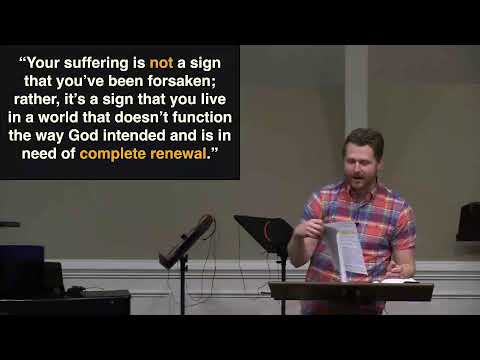
Despite that, he wrote a little book called: “Suffering: Gospel Hope When Life Doesn’t Make Sense.” In it, he gives voice to the questions of “does God care about me?” and “Why are you letting this happen?” He had real pain, real reason to wonder about God, and instead he wrote the following quote that stuck with me:
“Your suffering is not a sign that you’ve been forsaken; rather, it’s a sign that you live in a world that doesn’t function the way God intended and is in need of complete renewal.”
To my knowledge, it’s one of Paul’s most well-known and sold books. So even in Paul’s pain, God is still able to use it for good by ministering to others who are suffering.
As the resurrection and the life, Jesus is the one who is ushering in that total renewal, my friends. For those of you in a season of suffering, you are not forsaken.
Now, how do you actually live this out? It’s great to know Jesus is compassionate and that he cares and he has purpose behind our pain.
Jesus asks Martha a question in verse 26 that cuts right to the heart of everything: "Do you believe this?"
Not — do you know why this is happening? Not — why aren’t you trusting me more? Just: do you believe this?
So let me ask you the same thing this morning. And I want to speak to two groups of people here.
If you're in a season of suffering right now —I want you to hear this: you don’t have to hide your questions from Jesus. Mary and Martha didn't. They walked straight up to him with their grief and their disappointment and said "where were you?" And Jesus didn't flinch or condemn them. He wept with them. He weeps with you.
So this week, I want to give you one simple, concrete practice: go home and read John 11 slowly. Not as a Bible study — as a conversation. Bring your name into it. Where Mary says "Lord, if you had been here" — let that be your voice. Let your specific hurt, your specific question, sit in that story. And as you do, look for the weeping Christ. Let his tears remind you, the way Aslan's tears reminded Digory, that he is not indifferent to what you're carrying. Then, if you're able, share what you're going through with a trusted friend this week. Suffering in isolation is one of the enemy's favorite tools. Don't let him have it.
And if life is relatively stable for you right now — things are okay, no major crisis — I want to gently say: this sermon was also for you. The Christian walk is not one of ease, it’s one of picking up your cross and following him. Suffering will come so are you ready for it? So do the same thing: read John 11 this week. Get familiar with this story now, while things are okay so you’re ready to face trials in the future.
For both groups — the hurting and the stable — here's the thing I want you to walk out of here with today:
Jesus meets your deepest doubts with his compassion and power. Your pain is not invisible to him. Your questions don't scare him. And because of his resurrection, not a single moment of your suffering is wasted. He is making all things new — and that includes whatever you walked in here carrying today.
So, like Jesus asked Martha: Do you believe this? Let me pray.
-

I am the Good Shepherd (05/03/26)
Good morning, friends! We’re in week 4 of our I AM series in the Gospel of John. This series is based on the most important question Jesus ever asked—and still asks us today which is “Who do you say I am?” As we look to answer that, we can find ourselves in the Gospel According to John. One unique feature of John’s Gospel is the seven ‘I AM’ statements—where Jesus reveals that he is Yahweh and shows us who he is. We’re going to focus on the fourth I AM statement today.
In the third Star Wars film, Anakin Skywalker is a loyal Jedi Knight. He fights for peace, the security of the galaxy, and the freedom of the republic. He’s a little annoying but mostly, he cares about protecting innocent lives. He has followers – troops under his commands and close Jedi friends. But throughout the film, we begin to see moments of darkness in Anakin. Soon after, Anakin turns to the dark side and transforms into Darth Vader – hurting the very people who he was called to lead. Anakin’s betrayal cuts deep if you’re a Star Wars fan.
But, it got me thinking how often we follow something or someone only for it to betray us. In a much deeper way in John 10, Jesus is talking to a group of people who have been betrayed by bad shepherds – shepherds who were supposed to care for them. They’ve been abandoned, used, and failed by their leaders – just like Anakin failed his fellow Jedi knights. So, Jesus arrives on the scene to say he’s the good shepherd – one who won’t abandon his sheep, one who won’t use them for his own benefit, and one who won’t fail.
Today, we’ll be meditating on Jesus as the Good Shepherd. By the end of today, you’ll see that should let Jesus lead your life instead of the things that will ultimately fail you. Why should we let Jesus lead our lives? In John 10, we’ll see three compelling reasons why.
Will you stand with me if you’re able as we read God’s word?
Jesus knows you completely and won’t reject you.
In verse 14, Jesus says something startling when you dwell on it: “I know my sheep and my sheep know me, just as the Father knows me and I know the Father.” Jesus uses the closest relationship imaginable – the father and the son – to show how he knows us. Jesus and the Father, two persons of the Triune God, have existed in perfect fellowship with each other since forever. They know each other’s character, attributes, desires, etc. Out of perfect love and unity, they’ve decided to redeem a fallen humanity. There isn’t a single thing that they don’t know about each other.
And that’s how Jesus says he knows you and me. Douglas MacMillan was a Scottish pastor in the late 20th century. Before he was called to serve as a pastor, he was actually a shepherd. He’d often share a story where he was riding a train through the Scottish countryside with a fellow shepherd. As they were riding and moving at a fast pace, they could see 4 sheep close to the tracks on the side of a fence. In a moment’s notice, Douglas could tell they were his sheep because the way their wool grew, the shapes of their bodies, and the tag in its ear – even though he kept hundreds of sheep. Good shepherds know their sheep and they are the experts on them.
That’s how Jesus knows us too. Do you ever just sit with that? Jesus knows you. Yes, you. The good things that make you feel good inside: perhaps your skills, gifts, family relationships, whatever. But, he also knows the bad things: perhaps the thing you’re too ashamed to talk about, that pattern of sin that you find yourself stuck in or that deep struggle and suffering you’re going through right now. On one hand, we should take great comfort in being fully known by Jesus. But on the other hand, if we’re honest, it freaks us out a little bit. Why?
In all of us, we share a common desire for safety and love. But, you can only experience safety and love if you dare to be vulnerable. Vulnerability can be hard for many of us – we live in a culture that only celebrates the wins in our lives, never our losses. Or perhaps we’ve shared vulnerability in the past and it’s been met with judgement. If that’s you, I’m so sorry that happened. So where we’ve been let down by others or by culture, Jesus knows us fully and yet still loves us.
Psalm 139 tells us: “You know when I sit and when I rise; you perceive my thoughts from afar. 3 You discern my going out and my lying down; you are familiar with all my ways.” But, it gets better than that: Jesus just doesn’t just know us and love us, we belong to him just like he says in verse 12. That can be hard for those of us who struggle with vulnerability or feelings like we’re not good enough because we think that the more someone knows about us, the less they’ll like.
If Jesus really knows everything about you… the natural question is: Why doesn’t he walk away?
2 years ago, I was on a daily quest to find a suitable used pop-up camper for my family. I had read dozens of articles, reddit posts, YouTube videos, and more to become an expert. Specifically, I wanted a Coleman pop-up camper. From my research, I knew the problems to avoid: avoid these particular years because they have a poor roof construction, floor sagging, avoid this, avoid that. If I saw one issue, I was done with it and moved on.
Unlike me in my search for a pop-up, Jesus doesn’t write us off when he knows our issues. Rather he says that he knows us and he is still our shepherd. He knows the flaws that we have and still chooses to lead us. I’ve heard it said that the only qualification for coming to Christ is to admit that you are unqualified.
But since Jesus knows us and we belong to him, he doesn’t abandon us like the hired hands. He doesn’t run away because is a good shepherd – he’s the better shepherd. Why is he so much better than the hired hands? He doesn’t just stay with the sheep – he does something that all normal shepherds don’t want to do.
Jesus proves his love by dying for you.
As Jesus is speaking about sheep and shepherds, there’s a chapter in the Old Testament that the Pharisees would have been thinking about.
In Ezekiel 34, God rebukes the religious leaders of God’s people in that day. The religious leaders would be considered shepherds, and the people would be considered the flock. So, why is God rebuking them? For a few reasons:
· The shepherds did not love or bother to know their sheep
· The shepherds did not care if a sheep was lost, hungry, hurt, or weak
· The shepherds bailed on the sheep in their time of need
But God makes a promise to the hurt flock: he promises that one day, he will come and be their shepherd himself. He will be a better shepherd that will take care of his sheep, he will find those who are lost, he will strengthen and comfort the hurt, and he will protect them from their adversaries. So Jesus comes into say that he is the good shepherd.
He is not like the hired hands (ie. The Pharisees) who flee from their flocks in moments of danger. Instead, Jesus will lay down his life for his sheep. Well, why would Jesus do that? In real life, if a shepherd dies, the sheep are in more danger—not less. So why would he allow himself to die? Jesus knew our greatest danger wasn’t a wolf or a wild animal. Our greatest danger is sin and death.
The bible tells us that we are slaves to sin – meaning, we are owned by it, without an external intervention, we are helpless to free ourselves from its power. Sin causes us to become lost or separated from our creator, brings fear and shame in us, and hurts ourselves, others, and our world. So when Jesus lays down his life, he absorbs the punishment and effects that our sin creates into himself. Or as Paul says in Romans 5:8: God demonstrates his love for us that while we were still sinners, Christ Jesus died for us.
So, Jesus is wanting these hearers to realize: he’s better than those hired hands because he’s going to die for us. I imagine many of the original hearers were worried about Jesus: will he abandon me? Will he promise me the world and then leave when things get hard? Jesus’ statements are to demonstrate his faithful love that he will never leave you.
In the Wingfeather Saga (PIC), Nia is the mother of three kids, one of those kids in Kalmar. Long story short, Nia and her family found refuge in her hometown from a horrific war and enemy. But the townspeople are very skeptical of Kalmar because he looks different than everyone else and has made some mistakes. Kalmar feels shame and regret over what he did. So the townspeople are about to throw Kalmar in the dungeon because they believe he’s dangerous. But Nia stops them by enacting something called: “Turalay.” Turalay meant that if Kalmar was found guilty of a crime, Kalmar would not be punished but rather Nia would be. Nia has to slice her hand and put a bloody handprint on a tree in the town’s center to fully enact it. Nia’s bloody handprint on that tree served as a reminder to Kalmar that he was loved and that his mom deeply cared for him. In the coming weeks, Kalmar faced trial after trial but that bloody handprint on the tree was still there – reminding him of his mom’s commitment to him.
And in the same way, that’s what Jesus did for us. That’s what Jesus wants us to see at the cross. There may be times where we really ask: Jesus, are you actually a good shepherd? And he wants us to remember the cross where he died for us so we can say: Yes, you are the good shepherd because you dealt with my biggest problem on the cross. You’ll lead me through these other problems as well.
Because he rose again, he’s not just a shepherd who rescues you from danger—he’s a shepherd who actively leads your life.
Jesus leads you through death to life.
The shepherds in Jesus’ time would be familiar with two environments: the wilderness and lush green pastures where their sheep could graze and lie down to rest. The wilderness is a harsh place: there’s no water, there’s sharp rocks, there’s wild animals that threaten you, and potentially some criminals. On the other hand, green pastures sound so nice – there’s plenty of food, soft grass to sleep on, and relative safety.
If a shepherd keeps his sheep in one spot for too long, the sheep will eventually eat every blade of grass in that area. So, a shepherd has to keep his sheep moving to prevent that from happening. There aren’t just endless green pastures in Israel so they’d have to go through some wilderness to get there. If I’m a sheep, that sounds a little annoying – I don’t want to walk on rocks or harsh dirt. I don’t want to sleep on rocky terrain. But we need to head through the wilderness to get to the green pastures.
It’s the same way in our lives – when Jesus died for us and we believe that, he becomes our new leader and shepherd. He’s the one who guides us from place to place. Jesus, as the good shepherd, knows where he’s taking us – we often don’t know, we’re just the sheep. As he’s leading us, he’s going to take us into the wilderness for some seasons. It may feel like things are getting worse for us, not better. Why would Jesus do this?
He says this in verse 17 – he lays downs his life but he has the authority to take it up again. So as he’s leading us into wilderness, his heart is to give us new life through it. Jesus has the authority to use all the difficult things in our lives to be transformed for our ultimate good. The reason why Jesus is the most qualified to lead you through the wilderness is because he’s gone through his own wilderness. He faced betrayal, abandonment, and death itself. But, he overcame death which gives us hope in the power of God but also in the presence of God.
The strong, capable, noble shepherd is with you. Jesus is leading you towards the green pastures but you need to head through some wilderness first. Because here’s the thing: if you only ever experience green pastures, you won’t really appreciate them. They’re just your new normal.
When I’ve traveled in my last role at Compassion, we’d be eating just what I’d consider a regular meal: a thin pork chop with rice, beans, and a coke. I was grateful to eat but it wasn’t a big deal for me. But then I’d see how the children’s faces would light up as the church volunteers would bring them a plate like mine. They’d devour it within a few minutes. Why? Because they know what it’s like to go hungry, so they deeply appreciate this hearty meal.
For us today, we share in the sufferings of Christ like 1 Peter talks about so we can also share in the glories of Christ as well. Our shepherd is with us in the wilderness and he’s leading towards green pastures – the pastures will not be a life of ease or comfort. But, the pastures are seasons where you experience a deep intimacy with Christ. The pastures are where you refresh yourself in the presence of the Lord and grow in holiness. Christ is after our whole hearts, untainted by sin.
So, my question for us after that is: what is leading your life? My encouragement to you is: let Jesus lead your life instead of the things that will ultimately fail you. As you think of that question: what is leading your life? What directs or shapes your actions? Who impacts your decisions on where to live, how to spend your money, or how to structure your time?
If Jesus isn’t the good shepherd of your life and leading you, you’re going to end up being led by something or someone that will fail you, abandon you, or exploit you. What do I mean?
If your spouse or your kids are what lead and shape your every action, what happens when they fail you? If your work, career, or salary level are what lead and shape your every action, what happens when you get let go? If people’s approval are what lead and shape your every action, what happens when you get criticized?
Jesus isn’t just a good shepherd, he’s a better shepherd than those other things. He’s the only who knows you completely and won’t reject you. He’s proved that totally by dying for you. He’s going to lead you through death to life. Your spouse or kids can’t be your savior, only Jesus can be. Your workplace will let you go if times get tough and job cuts need to happen. Your fight for approval from others won’t save you, it’ll imprison you. Family, work, and receiving praise are great things – don’t get me wrong. But, those things, when they become your main thing, become idols and they will crush you.
As we begin to sing one final song, I want you to reflect on and ask Jesus: what is leading my life? If it’s not Jesus, take some time to get right with him right here and right now. You’ve seen through today’s text who he is and what he’s done for you. He’s the only Good Shepherd you need and with him leading you, everything else will be kept in its proper place. If you need prayer, we have a prayer team in the back of the sanctuary ready to pray with you.
What is leading your life? My encouragement to you is: let Jesus lead your life instead of the things that will ultimately fail you.
Please stand, if you’re able, as we prepare to pray.
-
 • 4/26/26
I am the Gate (04/26/26)
Good morning, friends! We’re in week 3 of our I AM series in the Gospel of John. This series is based on the most important question Jesus ever asked—and still asks us today which is “Who do you say I am?” As we look to answer that, we can find ourselves in the Gospel According to John. One unique feature of John’s Gospel is the seven ‘I AM’ statements—where Jesus reveals that he is Yahweh and shows us who he is. We’re going to focus on the third I AM statement today.
First, I want to show you a picture of a door. But, not just any door. It’s the door to 10 Downing Street in London. This is the door to the Prime Minister’s residence in the U.K. It’s not open to the public and to get there, you’d have to sneak around secure fencing, 24/7 security, and more. But once you get to the door, there’s actually no keyhole and it’s made of steel. It’s blast proof meaning it should be able to withstand a direct explosion on it. Now, does this door scream “come on in?” No, of course not.
And it got me thinking that this is how people view God often. They view him as closed off, difficult to get to, and indifferent. But is that true? It’s not true.
Today, we’ll be reading John 10:1-10 to see that would be an incorrect view of God. And instead, we’ll see that God is not closed off – instead, he invites us in to his kingdom through the gate.
We will see that in Jesus alone, we find true freedom, unshakeable security, and a joyful life for today.
Would you please stand if you’re able as we read God’s Word?
Jesus Alone
In verse 7, Jesus makes the exclusive claim that he is the gate. He’s not just an option to getting right with God, he is the only option. That sounds harsh, I know. But, do you ever notice how when Jesus says something controversial or difficult, he doubles down? That’s what he does next in verse 9. Jesus expounds upon this idea that the only way to experience the gift of salvation is to enter through the gate of Jesus. It’s almost as if he is saying: in case I wasn’t clear, I AM the gate not just an option for you.
I want to briefly show you how important gates or doors are in the bible. Riveting stuff, I know? First, just what a gate does: a gate marks a boundary between those on the inside and those on the outside. Throughout the Old Testament, gates or doors were often used to separate the heavenly and earthly realms. For instance, the holy of holies in the temple was separated by a gate or veil. On one side, the very presence and fierce holiness of the Lord was there – bringing heaven down to earth. On the other side, the Levitical priests made sacrifices to atone for the sins of the people. All of this was separated by a veil, door, or gate. Without those sacrifices and following God’s instructions on one particular day, there was never a way to cross that veil or gate.
And now, Jesus says that he is the gate. He’s the one who controls that now, it’s not about the sacrifices by the priests anymore. It’s about the sacrifice of Christ, once and for all – that’s why the veil tore in two when Jesus died. In effect, that said the barrier is gone – the way to God is open! So, Jesus is the ultimate revelation of heaven coming down to earth. Leslie Newbiggin, in his commentary, put it this way: “Jesus is the ladder by which traffic between heaven and earth is carried.” So, when we enter his gate as his followers, we enter into the Kingdom of Heaven.
When you start to talk about Jesus being the only gate or entryway to God, people often call that idea closed-minded or arrogant. Ultimately, it’s neither of those things though – it’s not arrogant because Jesus is saying that this is true, it’s just reality. The bigger question folks should be asking is: is Jesus right?
Imagine with me this scenario. You have a life-threatening sickness, so you go to the doctor. Your doctor tells you: look, I can heal you with this brand-new treatment but it’s the only treatment that’s going to work. All the other treatments won’t give you what you need. You look at your doctor and say: Wow, you’re so arrogant saying there’s only one way to be healed. How do you know those other treatments don’t work? Your doctor looks at you, stunned. Your doctor is the expert, he knows what you truly need.
And it’s the same way with Jesus. Jesus knows exactly what we need. He has the authority to claim he is the only way because he is God in the flesh. To disagree with him on this claim is to disagree with his divinity. But because of that, how should we respond?
We must first understand this truth for ourselves – we must not look within ourselves to see if we are saved or to look at our good deeds. Instead, we must enter through Christ and rest in his free gift of salvation. But if he is truly the gate, our hearts must break for those who haven’t found Jesus. Our hearts must not stop at mere heartbreak for them but be spurred into action for them as well. It’s not on us to save, God does that but it’s our responsibility to spread the message – faith comes by hearing the Gospel, not just by the way you live your life. Yes, live your life as a message but you must also share that message too. I always loved how Charles Spurgeon expressed this thought: “If sinners be damned, at least let them leap to Hell over our dead bodies. And if they perish, let them perish with our arms wrapped about their knees, imploring them to stay. If Hell must be filled, let it be filled in the teeth of our exertions, and let not one go unwarned and unprayed for.”
So if Jesus alone is the gate, then what does life inside the gate actually look like?
True Freedom
In these verses, Jesus is helping us to see that there are real thieves and robbers who are out to deceive us. He is talking about the Pharisees and you can see that in verse 1. Why is he calling the Pharisees thieves and robbers? They’re leading people astray. Rather than encouraging faith in a God who interacts with humanity, they encouraged strict adherence to the rules or traditions that they established. They placed obedience through effort instead of obedience through reliance on the holy spirit. They placed God’s love as something they need to earn rather than a free gift to receive. They placed their good rituals or commands as a formula to follow instead of a way to serve their neighbor and experience God’s presence. Obedience to God is extremely necessary but it flows from God’s love.
But, here’s what happens to people in those situations: you feel like the weight of the world is on your shoulders. You feel the weight of your own sin and it’s only amplified by more and more law without grace. You begin to actually resent God because he has a standard that you’ll never measure up to. You end up becoming enslaved to the mantra of try harder, try harder, try harder. If you’ve been there, does that ever work? No, it doesn’t – you’re a slave to spiritual burdens.
There are also thieves and robbers who will try to convince you that true freedom is being able to do what you want when you want. Scripture tells us though that this too will fail: why? Because, you’re a slave to sin and we’ll start to choose things that are genuinely destructive to ourselves and others. Those are things that are thieves and robbers. But, Jesus is the one who gives you freedom.
How do you break out of spiritual prison? Jesus tells us in chapter 8: he says that if we know the truth, the truth will set you free. Jesus is the truth and we enter the gate. Then, we are free from being a slave to spiritual burdens and free from being a slave to sin. So, does that mean we can do what we want once we know Jesus? No, we don’t define freedom – Jesus does.
Some of you may be thinking or may know people who would think this way…Jesus doesn’t give true freedom, he just gives us more rules to follow like we need to pray, we need to love, we need to forgive, etc. He doesn’t bring true freedom. Let me show you a picture. G.K. Chesterton, the famous British author, wrote about this. He tells the story of a bunch of boys who would often play alongside these cliffs in the U.K. At that time, there were these sturdy fences on the edge of the cliffs to prevent anyone from tumbling down. Those fences were there for safety and gave the boys the opportunity to truly live and have fun. But, some enlightened people believed the fences weren’t allowing the boys to experience true freedom so they removed the fences. Now, the boys were too afraid to play because they could easily tumble down and hurt themselves. Which boys experienced more freedom? Well, the boys who could play within the safe boundaries of the fence.
In the same way, that’s how Jesus offers us true freedom. It’s better than legalism and doing whatever we feel is best. But true freedom is embracing our God-given limits, taking God at his word and obeying, and trusting in his free love then we will be filled with joy. When Jesus commands us to do something, it’s for our ultimate good – he is, after all, the author of life. He knows how life should work and his commands are for the best.
So, I would ask you: are you experiencing the freedom that Jesus offers us? What thieves and robbers have come into your life? Do they still have a residence in you or have you given them to Jesus? Have you experienced Jesus as the gate?
When you enter through the gate that is Jesus, you’re not entering something weak or temporary. You’re entering something strong and steadfast which is why Jesus also brings:
Unshakeable Security
Take a look at verse 9: Jesus says that we come in and come out. What’s that mean? It means that Jesus is with us in the comings and goings of life. Jesus is like a security guard as we go about our day. Because his presence is with us, there isn’t a time where we are ever truly alone – this gives us comfort on our sad days, strength in our moments of weakness or temptation, and peace when we’re feeling anxious.
When life does get hard, scary, or difficult, this text also should help us remember that we are secure in Jesus’ sheepfold. Let me show you another picture. In ancient Israel and still present day, shepherds are actually the gates for their sheep. Let me show you a picture of a sheepfold. In that tiny gap, that’s where the Shepherd would sleep. So, few things worth noting: there was no way a wolf or someone could crawl over a Shepherd without them noticing. Also, there was no a way a person could crawl in on the side, lift a sheep over the wall, and steal them without the shepherd noticing.
For us, Romans 8 tells us that: “38 For I am convinced that neither death nor life, neither angels nor demons, neither the present nor the future, nor any powers, 39 neither height nor depth, nor anything else in all creation, will be able to separate us from the love of God that is in Christ Jesus our Lord. “ We are secure in his fold, nothing can separate us from the love of God just like a sheep couldn’t be separated from his shepherd in the fold.
Imagine the enormity of Jesus as the gate: he tells his friends that the gates of hell will not prevail against him. He wasn’t held down by the powers of sin and darkness. He has the power to reach down into death itself and rescue people like Jairus’ daughter, Lazarus, others, and all of us here. He has the power to restore sight to the blind and walking to the lame. If that’s who is covering the gate, why should we have cause for worry in our lives? We are secure in the sheepfold of Jesus. Will there be tough times and times of suffering? Yes. But God uses the tough times in our lives to shape us and make us look more like his son. And when we feel overwhelmed like we can’t go on, we don’t have to go far for help – he’s right there.
But, what’s even more beautiful is how accessible Jesus is in this statement. It says “whoever enters through me.” Other translations say “if anyone enters.” That tells us Jesus is available to every single human being on the face of the planet.
There’s no condition on this. It doesn’t say: only the poor or only the wealthy can enter. It doesn’t say only those who know a lot of the bible. It says whoever enters through me. Jesus is available for every single one of us. I love the way that Dane Ortlund describes Jesus: “Jesus is the most accessible person in the universe. You don't have to go through security to get to him. He doesn't say, Take a ticket and get in line. He doesn't put you on hold. He is supremely accessible. There's no minimum bar you need to get over to get to him. All you have to do, actually, is collapse in order to get into the heart of Christ. You have to humble yourself enough—something that most of us have a very difficult time doing—to fall into his arms because he is lowly.”
But, do we look to Jesus for our security? Do we view him as accessible to us? Perhaps we settle for lesser things: Jesus seems too abstract so I’ll place my security in my job, savings account, or perfect relationship. Prayer seems too hard so I’ll watch Youtube shorts for a few hours instead.
My friends, let us seriously consider the breathtaking invitation of Jesus as the gate. Let yourself experience his grace anew!
If we are secure in his accessible arms, that means we can experience abundant life like he describes in verse 10 which is our final point for today.
Joyful Life Today
When you think of the phrase, life to the full: what do you think? It really means life that is over the top. That’s what Jesus promises us in this passage of Scripture. Now, let’s be clear: he’s not promising that you’re going to live this crazy life where you never run out of money, you never have any worries, or you never have troubles today.
But, he is saying that you will have him. And Jesus is enough. Those other thieves and robbers are going to leave you disappointed and alone. Jesus promises to give you life not built on happiness but one that is built on joy. Jesus brings you joy. Because of Jesus, death has been defeated. Because of Jesus, your worst moments in life can be redeemed. Because of Jesus, you have a God who is on your side and who is working for your good in your life right now even if you can’t see it. When you step through the gate and experience more and more of Jesus, I promise you’ll find joy in following him. But, you need to step through.
Worship team, please come on up.
So, you’ve heard what Jesus says about Himself today. He doesn’t say he’s a gate. He says he is the gate. That means this isn’t just information to consider—it’s a decision to make. Because every single one of us is already building our life around something. But Jesus is clear: If it’s not him… it won’t deliver.
What promises freedom becomes slavery. What feels secure can vanish. What claims to give life leaves us empty.
He said: “I am the gate.” Not just to keep people out… but to bring people in. To bring you in. Into salvation you can’t earn, freedom you don’t chase, and security you don’t maintain. Into a life that is full—not because it’s easy, but because He is with you in it.
So the question isn’t: Do you agree with Jesus? The question is: Have you entered through Him?
Or are you still standing outside the gate? Because the invitation is open—but it won’t always be.
Jesus stands as the gate, and He says: “Come in.” Come in…and find life. Not later. Not someday. But now.
And for those of you who have already entered through the gate— this is your reminder: Stop living like you’re still outside. Walk in the freedom He’s given you. Rest in the security He’s secured for you. And go out into the world with urgency and compassion—Because there are still people standing outside the gate.
They need an invitation to come through. Let’s be the kind of people who don’t just admire the gate…but who walk through it, live in it, and lovingly call others to come in too.
Because Jesus alone is the gate to life.
-
 • 4/19/26
I am the Light of the World (04/19/26)
Good morning, friends! We’re in week 2 of our I AM series in the Gospel of John. This series is based on the most important question Jesus ever asked—and still asks us today which is “Who do you say I am?” As we look to answer that, we can find ourselves in the Gospel According to John. One unique feature of John’s Gospel is the seven ‘I AM’ statements—where Jesus reveals that he is Yahweh and shows us who he is.We’re going to focus on the second I AM statement today.
Now, I’m about to say something controversial here: I am not a huge fan of National Lampoon’s Christmas Vacation. You know the one with Clark Griswald? I just don’t think Chevy Chase is very funny or a good actor…I’m sorry. But, in that film, Clark is obsessed with decorating his home with as many Christmas lights as possible. He finally lights in a glorious moment in the film but it only flickers for a little bit. But in those few moments when the house is lit up, it’s glorious. The rest of the neighborhood looks dark compared to the light.
When I was working on the sermon for this week, I was reminded of that film because the light served as a beacon of hope for Clark that his Christmas and life were okay. But, that hope flickered and faded. So, today, we’re going to be in John 8:12 where we see Jesus as the Light of the World. He’s a better light than the Griswold house at Christmas and you best believe he’s going to stay lit for more than a few seconds.
So today, we’ll see how Jesus is the light of the world who gives us life, guides us, exposes our sin, and transforms us to reflect him.
Will you join me in standing as we hear the words of Christ?
Light gives and sustains life.
If you’ve been reading the Gospel of John with us, I’m hoping you can remember how John 1 began. In him was life, and that life was the light of all mankind. The light shines in the darkness, and the darkness has not overcome it. It also tells us that the true light that gave light to everyone came in the world. He was in the world and though he made the world, the world did not recognize him. So, that’s who John says Jesus is. But, who does Jesus himself see him as? He sees himself as the light of the world. Why is that significant?
If you’re a gardener or a succulent fan, you know the importance of light. We’re going to take it back to high-school science class and I’m hoping Brett Powell will correct me if I get photosynthesis wrong. Plants absorb light from the sun, convert that to energy, and use the energy to grow. What happens if plants don’t get enough light? Well, they die – snuffing out what could have been a beautiful reflection of God’s glory. And we don’t even think about it—but without light, life collapses. Here’s what’s so surprising about Jesus’ claim: he is saying I am that light that brings life!
In the same way, before Christ came, it would have seemed like the darkness was winning. Human beings fell into deeper and deeper dysfunction but Jesus arrived as the Light of the World. He came to bring light to the dark deeds of Satan and the poisonous effects of sin in us. Jesus doesn’t just bring light—he is the light. His life, death, and resurrection reveal that light to us. In the light of Christ, he offers new life – the life that we were meant to have. Jesus knows that without him as our light source, we will find ourselves in trouble. Paul echoes this same truth in Romans—life by the Spirit, death apart from Christ.
Now, that’s a harder pill to swallow. It’s often at this point that many skeptics (myself included before I came to faith in Christ) will balk at God or make the claim that Jesus seemed like a kind of cool teacher but I don’t believe the idea that he is God. But if Jesus is a good teacher, that means you have to seriously reconcile with what he said. Jesus doesn’t say he’s a light or an option for your spirituality—he says he’s the light. If that’s true, he doesn’t just help us—he defines reality. And if he rose from the dead, we don’t get to ignore him.
So, dear friends, have you chosen to allow the light of the world to give you new life? Do you rely on the Spirit to sustain your new life? Plants don’t create the light—they simply receive it and grow. We can receive more of God’s light through our time in the Word, prayer, serving, giving, worshipping together, and enjoying God’s good creation. I want us all to be healthy believers basking in the glory of Christ’s light.
Thankfully, light doesn’t just give us life and leave us to fend for ourselves. Light is actually a helpful tool for us here…
Light guides us when we cannot see.
Jesus’ timing of his declaration that he is the light of the world couldn’t have better placed, he intentionally set this up. What do I mean? In John 7, we get a timeline from John that is critical to us understanding the audacity of Jesus’ claim. John 7 tells us that this discourse happened during the Festival of Tabernacles or Sukkot. For those of you unfamiliar with Jewish holidays, the Festival of Tabernacles is an annual holiday for the Jewish people that they still celebrate to this day. It’s a holiday to commemorate how Yahweh protected Israel in the desert after the Exodus from Egypt. How did he protect them? Exodus 13 tells us: the LORD went ahead of them in a pillar of cloud to guide them on their way and by night in a pillar of fire to give them light. Those pillars were the very presence of the LORD in all of his dazzling glory and splendor.
Now, the desert is extremely dark at night. For a large group of people roaming the desert, they are an easy target for enemies. So, how does God help them? He gives them a pillar of fire so they could see. So as Jesus says he is the “Light of the World”, the Festival of Tabernacles is going on full-swing – the temple is lit up with multiple torches, lights, and huge menorahs with massive candles. They would burn these torches and candles all night and it would shine across the city of Jerusalem to remind the people of how God lit up the desert with his presence. On the final night of the festival, the Levitical priests would extinguish the torches and the candles to signify that the glory of the Lord had departed Jerusalem in the days of Ezekiel so now they had to wait for the glory to return with the messiah. All this is going on and this is when Jesus says: “I AM the light of the world.”
Do you see how audacious that claim is now that you know the background? We didn’t read the rest of chapter 8 but this is where the religious leaders get really really upset with Jesus because they get it: they understand that Jesus is making the claim that he is God in the flesh, the glory has returned to Israel, and he is giving light to the world. Since he is the light of the world, that means those who follow him won’t walk in darkness just like Israel wouldn’t walk in darkness when God’s presence was with them in the pillar of fire.
When I was a kid, I was on a travel basketball team. And God bless my parents because each Saturday was filled with a tournament somewhere far away and we didn’t know how to get there. In those days, there was a website called MapQuest which you could use to print out directions. In those days, if you missed an exit, you were really stuck because there wasn’t an app telling you: “Recalculating.” There was one particular tournament that was somewhere in the Harrisburg area and keep in mind that my parents both grew up and worked in the Baltimore most of their lives so they never went to Harrisburg. We got so lost at that tournament but eventually, we saw a Bass Pro Shops which anchored our sense of direction and guided us back towards the right exit. It was a multi-day tournament and Bass Pro Shops served as an anchor for us to know our exit that was easy to miss was coming up. Bass Pro Shops helped us get to our destination.
And in the same way, that’s how Jesus being the Light of the World guides us today. In our life, we are going to walk through times where we feel like we’re lost, disoriented, or wondering where God is. Take heart knowing that the Light of the World is your King and he can be the one who brings you through your time in the wilderness just like he did for Israel.
Light guides us but in guiding us, it also does something that we don’t always appreciate. Light…
Light exposes what is in the dark.
Jesus gives us a shocking statement in John 3:19-21 (read this). People loved the darkness instead of light…why? Because the light exposes the evil deeds and sin for what they are. Verse 21 makes the case that if you live by the truth (ie. Follow Jesus), you step out from the dark and step into the light. So if Jesus is the Light of the World, that means he exposes the things that are kept in the dark. What do we keep in the dark then?
Sin. And sin thrives in darkness. When we try to cover it up or hide it, it spirals out of control. Think with me the story of King David – 2 Samuel tells us that David did everything right in the Lord’s sight except his situation with Uriah and Bathsheba. As he saw Bathsheba, he desired her and took advantage of her. So, there’s the sin of adultery and sex outside of marriage. But, what happens next? Turns out, Bathsheba is pregnant which is a problem for David because Bathsheba’s husband will find out. So, he calls Bathsheba’s husband, Uriah, back from the war and sends him home to Bathsheba hoping that they’ll be intimate so Uriah will believe the child is his. But Uriah is a principled man and doesn’t think it’s right to go home when his brothers are fighting. So, he sleeps at the palace. The next night, he gets Uriah drunk to try to send him home and still, Uriah stays at the palace. David switches up strategies and tells Joab to allow Uriah to be killed by Israel’s enemies by withdrawing the line of troops from Uriah. Joab does this and Uriah dies.
You see because sin is like black mold that it’s in a basement. Black mold thrives in humid and dark spaces which is why it often ends up spreading in basements. But if you look at a house with black mold in the basement, it won’t really be seen. You can even walk into the first floor and not notice it. Everything looks just okay. Here’s the thing though: just because it’s not noticeable right now, doesn’t mean it’s safe. If you don’t deal with black mold, it continues to spread and cause some serious issueswhy would you leave black mold in your basement? Why not deal with it?
And that’s my question for us all today: do you treat your sin like black mold in a basement? On the surface level, you look okay – you’re here today, that’s a good start. You pray sometimes. But deep down, there is sin in your life that you’re terrified of others finding out. You feel like God certaintly won’t forgive you this time. You’ve created your own prison and do you know how you get out? David’s saga will show us how.
The prophet Nathan confronts David of his sin. Nathan forces David to bring the sin into the light and out of darkness. David recognizes the errors of his ways and cries out to God for forgiveness. He eventually pens one of the most well known Psalms praising God for his forgiveness and pleas with God to make him white as snow. Why does God work that way?
John tells us that Jesus is full of grace and truth. Truth because if he is truly THE light of the world, that means he has the power to expose all the ugly things within us and within our world. Being the light, nothing is hidden from Christ’s eyes. But he’s also full of grace because if he is truly THE light, he sees the ugliness and died for those sins and rose to new life to display his power over death itself. The darkness of death couldn’t overcome Jesus. And in the same way, the darkness of our sin is no match for bright and powerful love of Christ. All it takes is crying out for forgiveness like King David. John says in one of his later letters that if we say we have no sin, we deceive ourselves and the truth isn’t in us. But if we walk in the light and confess our sin, we find forgiveness and cleansing from our unrighteousness.
So today, my brothers and sisters: what stuff do you need to bring into the light? I hope you don’t feel like I’m harping on sin too much but that’s the truth of Christ’s character. But as you step into the light, you won’t find condemnation – you’ll find the life and freedom that you desire but it’s only available if you’re willing to live without secrets or sin hiding in your heart. Allow the light of Christ to expose it and find the healing you need.
When you continue to walk in the light by allowing Jesus to work in the messy parts of your soul, the Spirit slowly changes you. Where you once felt condemnation, you begin to feel freedom and love found in Christ. As you’re changing, you can change those around you which is our last point:
Light reflects and shines beautifully.
Shortly after the temple conversation, Jesus leaves the temple and encounters a man who had been blind from birth. Jesus again uses the title of being the Light of the World. Jesus spits in the mud, puts it on the man’s eyes, and the man is healed. This man was living in darkness since he was born, imagine that with me. But all of a sudden, he meets Jesus, the light of the world, who brings him out of physical darkness.
Soon after, the man is being interrogated by the religious leaders. He is exuberant as he shares his testimony despite the leaders annoyance at him. He boldly declares that if Jesus isn’t sent from God, he couldn’t do anything. Later on, Jesus catches up with him and the man who was blind worships Jesus. Because his life was changed by the Light of the World, he was able to reflect that light and shine it in his encounters recorded in John and I’m sure in the rest of his life.
Worship team, come on up!
And it’s the same way for us today – if we follow the light of the world, that light is now in us. We were blind once when we were lost in the darkness of sin. But, Jesus Christ came to shine his light in our lives, to die for us while we were still sinners, and to rise again showing sin and death doesn’t have the final word anymore. Unlike Clark’s house in Christmas vacation, Jesus doesn’t flicker or go out. His light doesn’t fail and he won’t fail you.
I want you to ask yourself: Are you living in the light—or still hiding in the dark? While we worship God through this last son, ask yourself that question. If there’s something that is still hiding in the dark, I’m going to invite you to be vulnerable and share that struggle with a friend or member of the prayer team. So, I invite you to come out of the darkness, step into his light, and live a life where God’s glory shines brightly through you. Amen?
-
 • 4/12/26
I Am the Bread of Life (04/12/26)
Good morning, friends! Back in 1920, there was a nutritionist named Victor Lindlahr who coined the phrase “You are what you eat.” And what he meant by that statement if you eat junk food, your body would be like junk. But if you ate healthy food, your body would be healthier. When I was in high school, I ate frozen chicken nuggets, Capn Crunch, and baked beans for most of my meals. You know how I felt because of that? I felt like junk. So, that phrase can be true of our physical bodies. But, what about the phrase being true in the spiritual realm? For our faith walk with Christ, what are you eating? Because Jesus doesn’t say we need to just eat better, he actually says he is the food or source of life that we need.
Last week, as I was closing our Easter sermon, I posed a question that Jesus asked his disciples: who do you say I am? His disciples answered that some people said, Elijah, a prophet, etc. But, Jesus pressed them again: who do you say I am? Peter boldly declared: You are the Messiah, the Son of God. No matter who you are in this place today, Jesus asks that same question: who do you say I am? As we look to answer that, we can find ourselves in the Gospel According to John. One of the more unique parts is John’s highlight of Jesus’ 7 I AM statements which Jesus intended to display that he is Yahweh but also highlight specific things about who Jesus is. We’re going to focus on the first I AM statement today.
And so today, we’ll be in John 6:25-59 to look at the story of Jesus saying: I am the bread of life. So, some context here: Jesus just did a major miracle, the feeding of the five thousand. Jesus took five loaves and two fish and multiplied them to feed over 5,000 people. After, the giant crowd wanted Jesus as a military king to war against the Romans. If he could do that with the bread and fish, what else could he do? But, Jesus withdraws to a lonely place. His disciples leave too. After walking on the water and rescuing his disciples, Jesus ends up on the other side of the lake. Folks track him down again and start asking him some questions.
So as we open up God’s word today, we’ll see how as the Bread of Life, Jesus saves, secures, and sustains his people. Will you stand with me as we read God’s word together?
Jesus saves us into something better.
In this story, we see that a group of people have been seeking Jesus which we may think is great but they are actually seeking Jesus for some bad reasons. There are 3 bad reasons why this crowd is seeking Jesus and we’ll see how Jesus offers something better instead:
1. Looking for satisfaction in a change of life circumstances.
In Verse 26, Jesus shares that they aren’t looking for him because he performed a miracle. They’re looking for him because Jesus fed them a good meal. But, here’s the thing: they’re going to become hungry again. In first-century Israel, you couldn’t just go to the convenience store for food or store essentials in a fridge. There wasn’t public assistance or bi-weekly pay periods. To get a daily meal, you had to be in a relative position of wealth which is why Jesus taught us to pray for our daily bread.
So, they are satisfied because they think they found a way to solve a major problem in their life: going hungry. But, Jesus’ rebuke is insightful because he tells them that they are going to be hungry again. They want to use Jesus to fix their problems in their life, solely for their own benefit. But they misdiagnose and think if this one issue is fixed, the rest of their life will be fixed. Jesus knows it won’t be and he has something better for them.
2. Doing the right things to earn God’s favor.
In Verse 28, the crowd of people ask Jesus what God requires of them? They’re hoping it’s going to be a how-to-guide to ensure that God always gives them what they want. They want a God that they can control and dictate. They are like the older brother in the parable of the prodigal son who only sticks around because he wants his dad’s stuff, not a loving relationship with his dad. In other words, they’re looking for a formula to approach God – effectively saying: “God, if I do this then you need to keep your end of the bargain.” But if they go down this route, they’ll also go hungry again because the human story is one of consistent failure to do the things that God asks of us.
They’re hoping for a quick fix but God isn’t interested in quick fixes, he’s interested in changed hearts. How do those hearts get changed? We have one final issue in this crowd and then we’ll see how Jesus changes hearts.
3. Erasing our doubts or worries about the future.
In Verse 30, they ask Jesus for another sign when he literally fed 5,000 people a day ago. They saw a miraculous sign from this teacher, greater than what their ancestors saw with Moses. In asking for a sign, they’re asking for further evidence that Jesus can meet their needs. They likely have real worries about their future and they’re wanting certainty that this Jesus guy is going to come through when they need it.
So, they’re hoping Jesus can fix that so they can coast through life without anxiety or without having doubts that God will come through for them. But, my friends, I’d ask: what is the nature and definition of faith if not believing God will come through, even and especially when you are worried about the future.
And perhaps, some of you are like this crowd. Some of you don’t want Jesus—you want what Jesus can give you. You want his blessings without his cross. You want his love without repentance. My friends, don’t settle for that lesser thing.
So, what is the better thing that Jesus saves you into? He saves you into believing in the one that God the Father has sent: Jesus Christ, the bread from heaven.
Jesus invites you to experience him as the bread of life which can satisfy your deepest desire. Because without Jesus, you’re always going to be hungry. There’s always going to be a circumstance that you wish you could change. Jesus can bring you the contentment and satisfaction your heart is looking for.
If you’re feeling worn out by trying to obey God or practice the way of Jesus, Jesus gives you good news: belief in him that leads to God’s favor not your commitment to do all the right things. Obedience to God flows from his mercy and grace, not the other way around. When you stumble, experience Jesus as the bread of life not as a God who gives up on you.
If you’re feeling worried about the future, Jesus invites you to trust that he will take care of you. In calling himself the bread from heaven, he’s inviting you into a daily exercise of trust that Jesus will carry you through. And in that daily exercise of trust, you’ll find a richer and deeper intimacy with Christ than you would if you didn’t trust him in that way.
C.S. Lewis once said in his collection of essays “The Weight of Glory” - “It would seem that Our Lord finds our desires not too strong, but too weak. We are half-hearted creatures, fooling about with drink and sex and ambition when infinite joy is offered us, like an ignorant child who wants to go on making mud pies in a slum because he cannot imagine what is meant by the offer of a holiday at the sea. We are far too easily pleased.” Infinite joy is offered to us in viewing Jesus as the bread of life but we often want Jesus as just a side order or find pleasure in lesser things like our careers, hobbies, etc. My encouragement is to experience Jesus as the bread of life and see how he can fill you.
After Jesus calls them out for seeking him for the wrong reasons, they ask him a critical question that many of us may have asked God ourselves which is: What must we do to do the works that God requires? Frankly, if we ask that question, we get to a crushing place which is why this next point is especially good news:
Jesus secures us to himself by never letting us go.
Moving through the text, we see a glorious truth that Jesus communicates: he tells us in verse 37 “All those that the Father gives me will come to me and whoever comes to me I will never drive away.” Further on in verse 39, Jesus says that he will lose none of those that the Father has given him. A few beautiful observations can be made:
· “All those” – Christ will not fail in saving and redeeming every single person that God the Father gave him. It’s all, not some or most.
· “The Father gives me” – the Father isn’t some angry God that Jesus calms down. Rather, he is the loving initiator of salvation. The Father loves to see his Son rescue wayward sinners.
· “and whoever comes” – the heart of God is open to every single person who wants to come to him, he doesn’t close himself off to anyone. We have a responsibility to respond even though the Father initiates.
· “never drive away” or “lose none of those” – when Jesus has got you, he’s got you. You don’t have to worry.
In these passages of Scripture, I don’t really want us to focus on the more controversial areas of theology. Instead, I want us to focus in on what Jesus means when he says: “Whoever comes to me, I will never cast out or never drive away.” Do you see the beautiful truth of that today, my brothers and sisters? Do you feel the security and comfort of that today, brothers and sisters?
In Gentle and Lowly by Dane Ortlund, Dane dedicates a whole chapter to this theme. And he plays out a thought that some of you have likely had when you’re in a dark place doubting if God really has got you:
“No, wait” – we say, cautiously approaching Jesus – “you don’t understand. I’ve really messed up, in all kinds of ways.”
I know, he responds.
“You know most of it, sure. Certainly more than what others see. But there’s perversity down inside me that is hidden from everyone.”
I know it all.
“Well – the thing is, it isn’t just my past. It’s my present too.”
I understand.
“But I don’t know if I can break free of this any time soon.”
That’s the only kind of person I’m here to help.
“The burden is heavy – and heavier all the time.”
Then let me carry it.
“It’s too much to bear.”
Not for me.
“You don’t get it. My offenses aren’t directed towards others, they’re against you.”
Then I am the one most suited to forgive them.
“But the more of the ugliness in me you discover, the sooner you’ll get fed up with me.”
Whoever comes to me, I will never cast out.
It’s not the strength of our faith that keeps us secure to Jesus, it’s Christ himself.
Our kids love to swim at my in-laws pool. They are confident these days in their little arm floaties and enjoy swimming without help from Katlyn or I. But in their early days, they’d be playing on the first step. Soon, they wanted to go deeper but they needed help so they would hold our hands. They’d take another step and hold onto our hands even tighter but at this point, they’re not holding themselves up – it’s me or Katlyn who is holding them up. A 2 year old’s grip is not very strong and if it wasn’t for myself or Katlyn holding them up, they’d fall deep under the water. But, as a loving parent, we won’t let that happen.
And in the same way, Christ strongly holds us even when we weakly hold on to him. Psalm 63:8 tells us: I cling to you; your right hand upholds me. That word cling is critical because it means that we’re often holding with everything we’ve got but it’s the strong arm of God that ensures we won’t fall. We have a responsibility to hold out our hands like my kids would and admit we can’t do this on our own. Thankfully, Jesus loves to pick us up and hold us so that we do not fall away.
Since we are secure in the arms of Christ, we are also reminded that it’s not a temporary thing. His security is with us throughout our life which leads us to our last point from today’s text.
Jesus sustains us by being united with us.
Although this passage is a glorious depiction of the faithful love of God and how he offers us something better, it doesn’t mean that we won’t have trials or difficulties. So when we go through those hard times, what does Jesus have to offer us? He offers us himself as the bread of life. As he calls himself the bread of life, this is an incredible title for Jesus. And it’s incredible because we are united with Christ – in verse 56, Jesus tells us that when we eat his flesh and drink his blood (more to be said here but can’t for this message), we become one with him just as he is one with the Father. Why is that good news? Is it possible for God the Son and God the Father to separate from one another? No, they’re each a person of the Trinity that have been in an eternal relationship before the creation of the world. In the same way, when you’re united with Christ, he’s not going to separate from you. Take hope, Christian!
When you’ve made another mistake or have stumbled again, how does God view you? Does he view you with disdain or hatred? No, he views you as righteous on account of what Jesus has done for you. Jesus has transferred his righteousness into you when you first believed in him.
When you’re going through hard things, where is Jesus? He’s with you, united with you and in you. He knows what it’s like to suffer betrayal, rejection, pain, sickness, and more. But, he’s with you. Suffering feels a little easier when you know you’re not alone and because of Christ living in you, you’re never alone.
When you’re tempted to sin and live an unholy lifestyle, you can fight against that temptation because Christ is with you. The Spirit’s power is with you but also the accountability that he’s with you is there. That will help you fight sin.
Being united with Christ is like receiving a heart transplant. The new heart isn’t taped on from the outside. It’s not something you visit once a week or consult in an emergency. The new heart is placed inside you. It becomes the source of your life, strength, and survival. From that moment on, your life depends entirely on that heart continuing to beat. If it fails, you fail. But as long as it lives, you live.
In the same way, when Scripture says we are united with Christ, it doesn’t mean Jesus is merely someone we admire, follow, or try to imitate from a distance. It means Christ lives in us. His life becomes our life. His righteousness becomes our righteousness. His strength becomes our strength. We don’t keep ourselves alive spiritually—we live because Christ lives in us and we can experience that every single day since he is the bread of life.
Worship team, come on up.
At the beginning of today, I shared that phrase of: You are what you eat. So, I’ll ask: what is it that you’re eating? Ingesting daily? What’s shaping you? James Clear, author of Atomic Habits, said: Every action you take is a vote for the type of person you wish to become. So, who are you becoming? If you’re a follower of Jesus, are you becoming more like Christ or more like the world?
In Verse 27, Jesus tells us to not work for food that spoils but instead work for the food that endures to eternal life which the son gives. This isn’t earning God’s love but returning to your daily source of life. If you are what you eat, are you eating the flesh of Christ? Drinking his blood? Those are strange words but they are the words of eternal life.
To help all of us work for the food that endures to eternal life, I have a 5-day devotional plan printed out in the back. It’s a plan that will take you through the Gospel of John 2 times in the next 6 weeks. If you don’t have a bible, there are tons of them in the cabinet in the back. So, Jesus sustains us as we return to him daily—especially through his Word. The Bread of Life isn’t just something to study—it’s someone to receive.
So, if you are what you eat, what is it that you’re eating? Over the next 6 weeks, I invite you to join me in reading the Gospel of John two times. You can use those for family devotionals or on your own. While reading, you will see that it is Jesus who saves, secures, and sustains his people because he is the bread of life. Amen?
-

