Into Your Hands I Commit My Spirit (11/08/26)
We’re going to start by reading one of the harshest things Jesus ever said to one of his closest friends. You ready?
[Read Matthew 16:21–24.]
In Matthew 16:16, Peter rightfully declares that Jesus is the Messiah and we all cheer Peter on! But next, Jesus begins to declare that the Messiah will suffer, he will be killed, and he will rise again. Now, Peter is caught off guard: in his mind, the Messiah shouldn’t suffer. So, Peter pulls Jesus aside to rebuke him and say: “Never, Lord! This shall never happen to you!”
And Jesus says, “Get behind me, Satan! … You do not have in mind the concerns of God, but merely human concerns.” Then Jesus goes even a step further: anyone who wants to follow him has to take up a cross too.
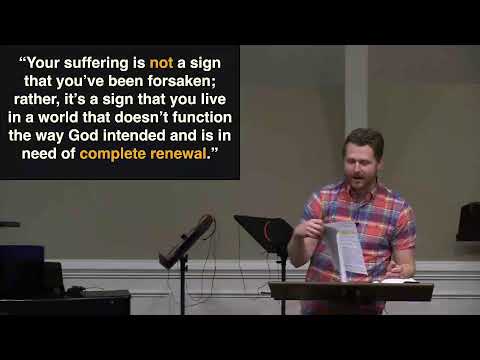
If we can be really honest, we’re like Peter too. We assume that truly following Jesus means a smooth life, not a harder life. And when things get hard, we’re caught off guard and wonder: why is this happening? But, the reality is: if you are truly following Jesus, his path leads you towards suffering not away from it.
So years later, Peter is writing the letter that Kathye just read. But, there’s a change: Peter saw the cross, the empty tomb, and he has the Holy Spirit now. So, he’s writing this letter to Christians who are suffering for following Jesus. And where he once said: “Never, Lord” – he’s now saying don’t be surprised! SLIDE Suffering for Jesus isn’t strange, it shows you belong to him.
Two Wrong Responses
So when suffering comes, there are two wrong reactions that Peter warns us of:
1. Surprise in verse 12.
2. Shame in verse 16.
Let’s talk about surprise first. This is a simple fact of life: there are going to be difficult things that happen to you, that are outside of your control. But, for the Christian: this is where things can get interesting. Many of us rightly reject the prosperity gospel (God wants you to be wealthy) as false but we sometimes still latch onto a different form of the prosperity gospel. It may not be financial prosperity, but we believe following Christ means we never get a cancer diagnosis, we never are treated unjustly, we never lose a job, and we never struggle with clinical depression or anxiety.
We can often adopt a worldly mindset that if we do good things, good things will likely happen to us. And if we don’t get good things, what have we done that God is punishing us? But, Peter flips the script here: he tells us not to be surprised at the fiery ordeal that we find ourselves in, it’s not strange. But, rather Peter says it has a deliberate purpose: God can redemptively use your suffering to purify your faith or to test your faith.
Many of you know Joni Eareckson Tada but in case you don’t, she’s a follower of Jesus who at age 17 had a diving accident and became paralyzed from the neck down. SLIDE And in her book “When God Weeps,” she wrote: “God permits what he hates to accomplish that which he loves.” God hates that Joni became paralyzed but he is still accomplishing something beautiful through her life. And to my friends today carrying suffering, God sees it. He hates it and he hates sin but trust that he is still accomplishing something through it – all out of love for you.
Now, Peter says there’s suffering you should be ashamed of, and suffering you shouldn’t be. Years back, Westboro Baptist Church was all over the news for having hateful signs where they rejoiced over soldiers killed in the Middle East or thanking God for AIDS. They faced public ridicule, for frankly, being jerks. The suffering and ridicule they faced was brought upon by themselves for being angry, abrasive jerks. Most of us don’t hold up signs like that. But, are you a person who cannot let a conversation go at the Thanksgiving table? Or we’d leave a nasty comment on social media? Then, we get upset because we have pushback?
Peter designates this sort of suffering as something you do to yourself but there’s a unique suffering for bearing the name of Christ. Now, some of you may are thinking: Anthony, I’m not facing arrests or beatings for following Christ. You’re right! But, we do have brothers and sisters who are. And even if we’re not beaten for our faith, there are still some ways we may suffer for our faith. Here’s what I mean.
When we suffer because we choose to follow Christ, Peter says we should praise God that we bear that name. But, Peter himself didn’t follow this example all the time in his life. Think back with me to the night Jesus is betrayed. Peter follows Jesus and the mob who arrested his rabbi at a distance. Soon, Peter finds himself in the High Priest’s courtyard where he asked by a servant girl: hey, you’re one of Jesus’s disciples, aren’t you? Peter responds: I don’t know the man. Peter does this two more times in the night and by the third denial, the rooster crows and Matthew and Luke tell us: Peter went outside and wept bitterly. Why would he weep bitterly? Peter was so afraid of the shame of being linked to Jesus that he did deny him and then he felt the shame after it.
Now, how many of us have quietly denied Jesus and felt the shame associated with it? How many of us have avoided speaking up in the break room, in a circle of friends, or anywhere else? Why would we do that? We’re afraid of the suffering or backlash that may come with it. And my friends, remember Peter’s story didn’t end there and neither does yours. After Jesus rose again, Christ restored Peter and encouraged him. And now years later, he’s speaking from a new identity where he exhorts us to not be ashamed but praise God when we’re insulted for the name of Christ. There is hope for you, my dear friend.
Why can Peter encourage us to do that? Is he just oversimplifying things? No, he actually tells us why in this passage:
What is really going on?
In verse 13, Peter tells us we can rejoice as we participate or share in the sufferings of Christ. Why would we do that? So we can be overjoyed when his glory is revealed at the return of Christ. Peter is repeating a common theme that we’ve seen come up again and again: Jesus is returning and that should give us strength to endure the difficulties we have now.
And that word “participate” means a special sharing that have with Christ when you suffer for him. See, you suffer with him because you belong to him.
And while you suffer, Peter is saying to draw strength from the future reality of Jesus’ return. Or Peter’s friend, the apostle Paul puts it this way in 2 Corinthians 4:17-18: “For our light and momentary troubles are achieving for us an eternal glory that far outweighs them all. 18 So we fix our eyes not on what is seen, but on what is unseen, since what is seen is temporary, but what is unseen is eternal.”
At this point, you may be thinking: cool, but what about the right now? I understand our future reality but it’s not here yet. Verse 14 takes us to the now. Peter tells us if we’re insulted because of Christ, you are blessed because the Spirit of glory and of God rests on you.
What could that mean? Peter is referencing Isaiah 11 which is a Messianic prophecy detailing how from the stump of Jesse (King David’s father), God will raise up a King and God’s own Spirit will rest upon him to demonstrate that he is God’s chosen King. He will judge and rule a Kingdom that spreads across the entire creation – healing God’s broken world.
Who is that King? That King is Jesus Christ who is a descendant of King David. And Jesus who entered into human suffering and he identified with us even as he was baptized. And as he was baptized, Matthew 3:16 tells us that the Spirit of God rested upon Jesus and that God’s voice was heard saying: “This is my Son, whom I love; with him I am well pleased.” And it’s that same Spirit who rested upon Jesus for his entire ministry: Jesus knew insults as he was mocked and rejected by his own people. While disgrace and insults rested on Jesus, something even more important and more powerful rested upon him: the Spirit of God. And Jesus’ path led to suffering and to his death.
But through his death, the Spirit that rested on him raised him to new life – demonstrating that sin, death, and hell have no claim over God’s chosen king. And now, he invites every one of us to repent and believe in him. And when we believe in him, that Spirit of God rests upon us – showing that we truly belong to God. So my friends, if you’ve ever been shut out, left out, or insulted because of your faith – rejoice! It’s a reminder that God calls you his own and you belong to him. Or as I said earlier, Suffering for Jesus isn’t strange; it shows you belong to him. What may be strange is never suffering for your faith.
“In fact, everyone who wants to live a godly life in Christ Jesus will be persecuted,” 2 Timothy 3:12 NIV what do we do with this?
In Acts 5, we learn that the apostles were arrested again by the religious authorities. They decide to let the apostles go after interrogating them but not before they whip and flog the apostles. And Acts 5:41 tells us something startling, it says: “Then they left the presence of the council, rejoicing that they were counted worthy to suffer dishonor for the name.”
Why could they rejoice? They knew the Spirit of God rested upon them and not even death itself could tear them out of the grip of God’s hand. And the same household God’s Spirit rests on is where Peter says God’s refining judgment begins.
The final judgment has already begun and it doesn’t start with the world, it starts with us. For God’s people, this judgment isn’t condemnation – rather, it is a purification of our hearts through the hardships that come from following Jesus.
See, God will not condemn his people anymore. It was Jesus himself who was condemned in our place and who suffered for us – the righteous for the unrighteous as 1 Peter 3:18 puts it. So whatever you’re walking through right now, it is not God punishing you. Jesus already took that, the righteous for the unrighteous. It’s simply the truth that suffering for our faith is a way God refines our hearts.
As I shared previously, when we would do a longer-term hosting with Safe Families for Children – things would be really difficult. When we started doing that, we had some pure motives but the challenges we faced revealed some impure motives as well: like wanting to be super Christians or to impress others. I’ll tell you what: nothing purified those motives like walking through the heartache, the joys, and frustrations of loving someone else’s kids like your own. God used those hard experiences to show what was really in my heart and to burn it out of me.
But, Peter goes onto issue a question of: “If it is hard for the righteous to be saved, what will become of the ungodly and the sinner?”
He essentially states that if believers go through such a hard refining fire, what will the final fire be for those who are not believers? And if you’re not a believer today, I’m so glad you’re here and listening. Suffering in your life can be a wake-up call. Like the prodigal son who realized his need for forgiveness from his father in a pigpen, suffering will have a way of orienting your heart that something needs to change. And that something is coming to faith in Jesus Christ and you can do it today as we pray later. Don’t wait for the final judgment when it’s too late, decide today.
And for those of us who do belong to God today, what are we to do in light of everything we just heard? Peter gives us a good idea in verse 19: “So then, those who suffer according to God’s will should commit themselves to their faithful Creator and continue to do good.”
Now, let’s make this concrete. First thing, Peter calls God your “Faithful creator.” The very God who made you is the same God who will faithfully care for you – regardless of how you feel. He’s the one who made you and who will resurrect you into new life. So, entrust yourself to him and continue to do good when you’re suffering. After all, this is what Jesus himself did. As Jesus suffered on the cross, he entrusted himself to his Father when he said in Luke 23:46: ““Father, into your hands I commit my spirit.” That is a surrender into the faithful care of God and it comes from Psalm 31:5.
And my friends, I want to invite you to do two things today. One inward focused and one outward.
First, I want you to pray how Jesus prayed by starting and ending your day by praying Psalm 31:5 – Into your hands, I commit my spirit. This is a prayer that simply tells God: “I trust you with whatever I’m coming through. I trust you even if this decision brings me suffering as a Christian.”
Second, I want you to continue to do good even if it costs you. That could mean:
· Mentioning you’re a Christian to others and share that you’re a part of a church
· Doing something good for someone who has treated you poorly because of your faith
· Return to doing a good thing you quit because it hurt and cost you something. It could be praying for your enemies, it could be fostering children, or it could be waking up a bit earlier so you can pray and read the scriptures before work.
Right now, you’re going to be given a card and it says: “The good I’ll keep doing this week: “ – fill it in with what fits your situation. Some of you may be in a season where you genuinely can’t do much. That’s okay, you can still practice the prayer every morning and evening.
The prayer alone is a step towards committing yourself to your faithful creator, regardless of your outcomes. And Peter would know this first-hand. In John 21:18-19, Jesus told Peter: “Very truly I tell you, when you were younger you dressed yourself and went where you wanted; but when you are old you will stretch out your hands, and someone else will dress you and lead you where you do not want to go.” 19 Jesus said this to indicate the kind of death by which Peter would glorify God. Then he said to him, “Follow me!”
As Peter was writing this passage, I imagine him recalling Jesus’ words – knowing that eventually, he would die for his faith. As I said at the start, if you truly follow Jesus, you can expect suffering for your faith. And yet, Peter is encouraging believers everywhere to commit themselves to their faithful creator and continue to do good. Eventually, church tradition tells us that Peter would be martyred by Emperor Nero and it’s hard for me not to imagine him also saying: “Lord, into your hands, I commit my Spirit.” And as he Peter said that, he enters into glory received into the arms of his Savior and friend, Jesus Christ. The man who once rebuked Jesus over his idea of suffering ends his life by praying Jesus’ own prayer of trust.
So, my friends: regardless of what you’re carrying today (and if it’s something heavy, we have folks in the back available to pray with you or get out of your seat to pray for someone who is struggling) – remember this: suffering for Jesus isn’t strange. It shows you belong to him. So, entrust yourself to him and keep doing good.